



Sales Agents in France: Entering Distribution Networks
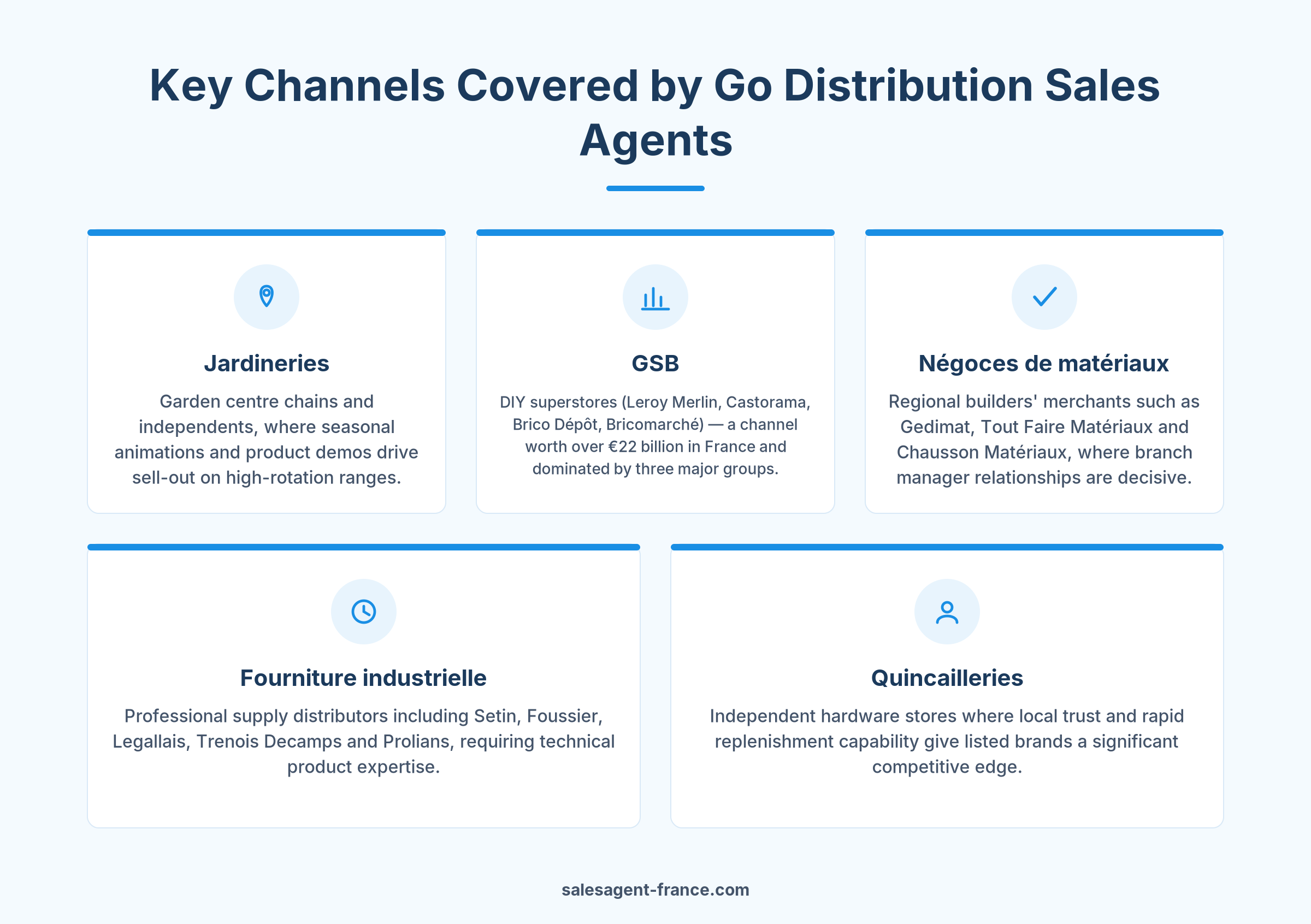
Working with sales agents in France is one of the most direct routes for a manufacturer to get its products listed in jardineries, DIY superstores, négoces de matériaux, fourniture industrielle outlets and quincailleries — without the overhead of a salaried field force. At Go Distribution, we have been doing precisely this since 1994, covering 31 departments across the South of France, from Bayonne to Marseille. This guide walks you through exactly how a sales agent operates inside these networks, and what you can realistically expect at each stage.
Why the Choice of Sales Agent Shapes Everything
France’s DIY and garden market reached €22.8 billion in turnover in 2024 for bricolage and €8.2 billion for jardin, according to NielsenIQ x GfK (February 2025). Even with the market softening after the post-Covid boom, the volumes at stake across DIY superstores, jardineries and négoces remain enormous. Yet three groups alone — Adéo, Kingfisher and Les Mousquetaires — control nearly 90 % of the DIY superstore segment, as reported by Businesscoot (2025). That concentration means buying decisions are made by category managers who receive dozens of product proposals each season. Without a credible, trusted field presence, your catalogue simply does not get in front of the right person.
Beyond the DIY superstore channel, the picture is more fragmented — and therefore harder to crack without local roots. Négoces like Gedimat, Tout Faire Matériaux or Chausson Matériaux operate through regional purchasing committees and rely heavily on the relationship a sales agent has built with branch managers over years. The same logic applies in fourniture industrielle, where buyers at Setin, Foussier, Legallais, Trenois Decamps or Prolians value continuity and product knowledge above all else.
An experienced multicarte sales agent in the bricolage and jardin sector brings something a salaried rep rarely can: an existing portfolio of relationships with store managers, category buyers and regional directors, built visit after visit over many years. That relationship capital is what shortens the listing cycle significantly.
How Sales Agents Get Your Products Listed: The Method, Step by Step
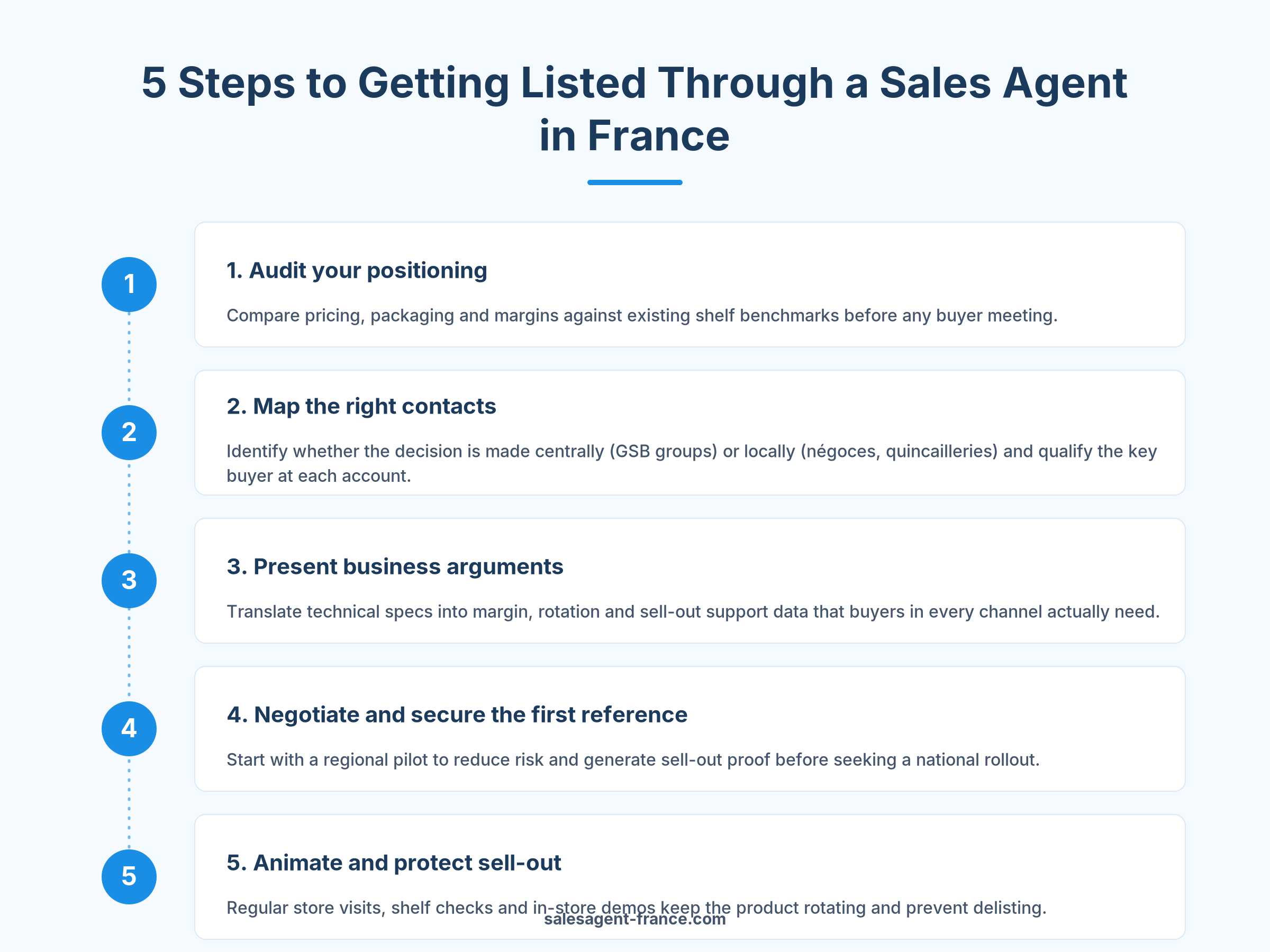
Step 1 — Audit Your Positioning Before the First Visit
A professional sales agent does not walk into a Leroy Merlin category meeting or a Gedimat regional buyer without preparation. The first step is an honest audit of your product range: pricing versus the shelf benchmark, packaging adapted to the French market (language, symbology, EAN codes), and the minimum order quantities compatible with each channel’s logistics. At Go Distribution, this preparatory phase typically takes two to four weeks and involves comparing your margins against what competitors already hold on the shelf. Products in fixation (SPIT), security (Master Lock, Mottez) or EPI (Difac) each face a different shelf reality — we adapt the pitch accordingly.
Step 2 — Map the Right Contact at Each Account
Not every decision follows the same path. In a DIY store like Bricomarché or Brico Dépôt, the relevant contact may be a regional category manager or a national buyer, depending on whether the product is referenced centrally or locally. In an independent quincaillerie or a Chausson Matériaux branch, the branch manager is often the decision-maker. The sales agent’s job is to identify and qualify the right contact at every account in their territory, then to prioritise visits based on volume potential. Our team follows roughly 1,700 points de vente across PACA, Occitanie and Nouvelle-Aquitaine — that granularity matters when you are trying to build a real distribution footprint.
Step 3 — Present the Range with Business Arguments, Not Catalogues
Buyers in any channel — garden centres, DIY superstores, or industrial suppliers — are not moved by glossy brochures. They want to know three things: what margin they will make, how fast the product will rotate, and what support you provide (merchandising, promotions, sell-out tools). A sales agent translates your technical product data into those business arguments. For a category like EPI, a buyer at Foussier or Legallais needs to know the certification level, the reorder cycle and the preferred display format before they even consider the price. Providing that information fluently, in French, face to face, is what converts a meeting into a trial order.
Step 4 — Negotiate Listing Conditions and Secure the First Reference
Getting your product listed is a negotiation, not a formality. The sales agent manages the back-and-forth on payment terms, minimum order quantities, return policy and promotional commitments. For a first reference in a DIY superstore group, it is common to start with a regional pilot — for example, a handful of Weldom or Bricomarché stores in the South — before seeking a national rollout. This approach reduces risk for both the retailer and the manufacturer, and gives the agent concrete sell-out data to use in the next negotiation. First references are the hardest to win; subsequent extensions follow more naturally if sell-through is demonstrated.
Step 5 — Animate the Point of Sale and Drive Sell-Out
Listing is only the beginning. A product that sits on the shelf without rotation gets delisted within two seasons. Sales agents at Go Distribution carry out regular store visits to check shelf presence, correct facing, replenish stock and flag any display issues to the store manager. Beyond routine visits, in-store animations and product demonstrations are a key lever — particularly in jardineries and DIY superstores, where a well-run demo of an Alpha Coupe cutting tool or a Boku smart toilet unit can generate immediate sell-out and reinforce the brand’s reputation with store staff.
Measurable Benefits for the Manufacturer
The question every commercial director asks is: what do I actually get, and how do I measure it? Here are the outcomes that experienced industriels consistently report after 12 to 18 months working with a mandated sales agent network in France:
- Faster time to shelf: a sales agent with existing account relationships can move from first contact to trial order in weeks rather than months, compared with building a salaried team from scratch.
- Variable cost structure: since the agent is remunerated on commission only, your distribution cost scales with revenue — there is no fixed payroll burden during the listing phase.
- Multi-channel coverage: a single mandate with Go Distribution gives you simultaneous access to jardineries, DIY superstores, négoces de matériaux, fourniture industrielle accounts and quincailleries across 31 departments — channels that require very different sales approaches.
- Real-time field intelligence: regular reporting from the agent provides competitive pricing data, shelf observations and buyer feedback that would otherwise require a dedicated market research budget. You can read more about the different missions a sales agent handles beyond pure selling.
- Sustained sell-out: the combination of account management, store animations and reporting translates listings into actual revenue — the metric that counts.
Questions fréquentes
How does a multicarte sales agent differ from a salaried sales representative?
A multicarte sales agent is an independent professional who simultaneously represents several complementary, non-competing manufacturers. They are not on your payroll and carry no fixed employment cost. A salaried rep works exclusively for one company, with all the associated social charges and management overhead. For a manufacturer entering France, the agent model reduces financial risk substantially during the market entry phase. You can explore this comparison further in our article on the advantages of working with a commercial agent.
What types of products are best suited to the DIY superstore and jardinerie channels?
Products in fixation, garden accessories, hand tools, security hardware, EPI and home improvement consumables are natural fits for DIY superstores and jardineries. The key criteria are: sufficient retail margin (typically 40–50 % for the point de vente), robust, shelf-ready packaging and a product that lends itself to visual merchandising. Technical products aimed at professionals are generally better directed toward négoces de matériaux or fourniture industrielle channels such as Prolians or Trenois Decamps.
How long does it take to secure a first listing in France through a sales agent?
Timelines vary by channel and product category. A regional trial listing in an independent quincaillerie or a smaller DIY store banner can be achieved in two to three months from the first visit. Central buying at the major DIY superstore groups follows a more structured calendar, often with seasonal ranges reviewed once or twice a year. An agent with established buyer relationships can identify the right submission window and keep your proposal visible between buying cycles.
Vous cherchez à distribuer vos produits en France ?
Go Distribution places your product ranges in garden centres, DIY superstores, builders’ merchants, industrial suppliers and hardware stores — 30 years of field experience across the South of France.
Conclusion
Sales agents are not a shortcut — they are a structured, proven method for entering French distribution networks efficiently and sustainably. The five steps outlined above reflect the reality of how listings are won and defended on the ground, from the first audit to ongoing point-of-sale animation. If you are a manufacturer looking to place your products across jardineries, DIY superstores, négoces de matériaux, fourniture industrielle or quincailleries in the South of France, we are ready to discuss your project. Contact the Go Distribution team and let us look at your range together.
