



How to Distribute Your Products in France: A Manufacturer’s Guide

Distributing your products in France means navigating a fragmented landscape of specialist trade channels, each with its own buyers, rhythms and referencing logic. Whether you are targeting jardineries, DIY superstores, builders’ merchants, industrial supply wholesalers or independent ironmongers, the rules of the game differ significantly from one network to the next. This guide lays out the practical steps we have refined over 30 years at Go Distribution — covering 31 départements from Bayonne to Marseille — so that you can enter the French market with a clear plan rather than a costly trial and error.
Map your channels before you approach a single buyer
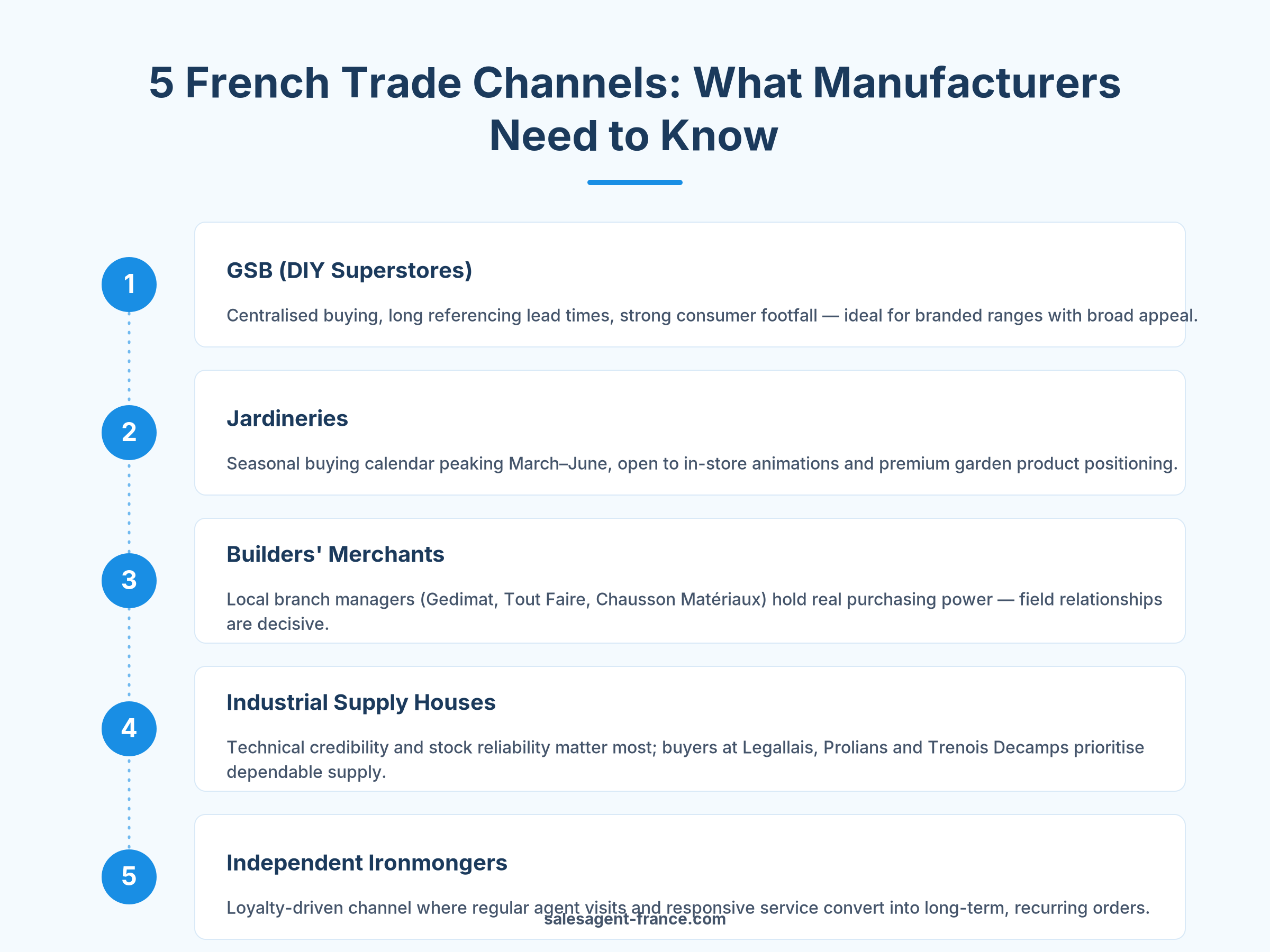
France’s distribution landscape for DIY, garden and hardware products is split into five distinct circuits, and they do not overlap as much as you might expect. DIY superstore chains such as Leroy Merlin, Castorama and Brico Dépôt serve a broad consumer audience and operate centralised buying structures with long lead times. Jardineries (garden centres) work on seasonal rhythms and tend to give more shelf space to brands that can support in-store events and demonstrations.
Builders’ merchants — Gedimat, Tout Faire, Chausson Matériaux and their peers — are structured differently again: local branch managers often hold significant purchasing authority, and the relationship with the counter team is just as important as any national listing. Industrial supply houses (Setin, Foussier, Legallais, Trenois Decamps, Prolians…) prioritise product reliability and technical documentation over packaging aesthetics. Independent quincailleries, meanwhile, value loyalty and service frequency above all.
Before you contact a single buyer, write down which two or three channels are the most natural fit for your product range. Trying to enter all five at once without dedicated field resources is the most common — and most expensive — mistake we see from European manufacturers entering France.
Build a referencing file that speaks each channel’s language
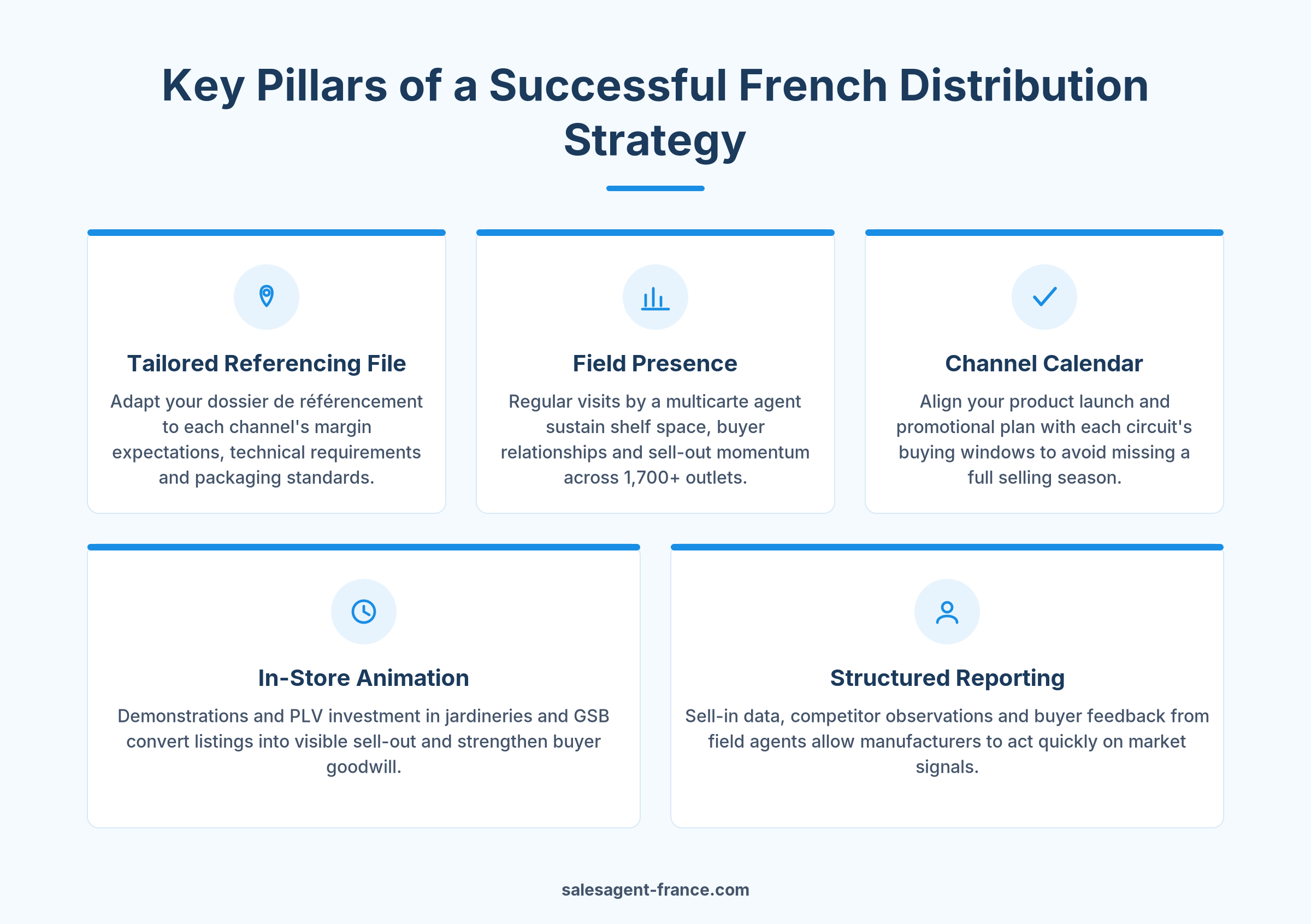
A referencing file (dossier de référencement) is your entry ticket to any French trade buyer. It needs to be adapted to the channel you are targeting — what a DIY superstore category manager wants to read is not what a Gedimat branch manager needs to see. For DIY superstores and jardineries, lead with consumer sell-out data, packaging dimensions, planogram compatibility and margin calculations. For builders’ merchants and industrial supply houses, technical data sheets, certifications and after-sales support take precedence.
In every case, include:
- A clear product range overview with EAN codes and packaging formats
- Recommended retail pricing and the resulting channel margin
- Minimum order quantities and delivery lead times
- Available point-of-sale materials (PLV, shelf talkers, display units)
- References from comparable markets if you are entering France from abroad
Translating your file into fluent French is non-negotiable — and we do not mean a machine translation. Buyers in French trade networks expect professional, localised documentation.
Use a multicarte sales agent to open doors that would otherwise stay shut
One of the most cost-effective ways to distribute your products in France is to work with a multicarte commercial agency. Rather than hiring a salaried sales representative — with all the fixed costs that entails — you mandate an independent agent who already visits your target accounts regularly and knows the buyers by name. At Go Distribution, our six field agents call on approximately 1,700 points of sale across 31 départements of Southern France (PACA, Occitanie, Nouvelle-Aquitaine).
The economic logic is straightforward: the agent’s field costs are shared across several complementary, non-competing product ranges. Your brand gains immediate access to an established portfolio of accounts — jardineries, DIY superstores, négoces de matériaux, fournitures industrielles and quincailleries — without having to build that contact base from scratch. You pay commission on sales made, not on prospecting time. For a manufacturer whose French turnover is still developing, the advantages over an in-house sales force are considerable.
The key requirement on your side: your product range must be genuinely complementary to the agent’s existing portfolio. A fixation product such as SPIT anchors, an EPI range like Difac, a locking solution from Master Lock — these sit naturally alongside other hardware and DIY references. A range that competes directly with a brand already in the portfolio will not be taken on.
Negotiate referencing terms with realistic expectations
Getting listed is only the beginning. French trade buyers — particularly in DIY superstores and jardineries — will negotiate hard on margin, promotional contributions and sometimes on listing fees or end-cap costs. This is normal practice, not a red flag. What matters is that you enter these negotiations knowing your floor margins and understanding what the channel typically expects.
In builders’ merchants and industrial supply houses, the negotiation is less centralised but no less demanding. A Legallais or Trenois Decamps branch will want to know that your product is in stock, ships reliably and comes with technical support they can pass on to their professional customers. Reliability and responsiveness matter more than promotional discounts in these circuits.
One practical point: avoid agreeing to promotional terms you cannot sustain. An introductory promotional price that you then cannot maintain long-term damages your brand positioning and your relationship with the buyer far more than a slower initial ramp-up.
Animate your shelf space — referencing without follow-up fades fast
In every French trade channel, a listing that is not actively maintained will erode. Shelf space shrinks, facing reduces, and eventually a competitor’s product occupies what was yours. Regular field visits are the most effective antidote, and they are one of the core services a multicarte agency provides.
In jardineries and DIY superstores, in-store animations and product demonstrations are powerful drivers of both sell-out and buyer goodwill. We have run successful demonstration campaigns for brands such as Mottez and Rapid precisely because the store teams saw that the manufacturer was investing in their floor space. In builders’ merchants, the dynamic is different: the counter team needs to understand and recommend your product. A brief but well-targeted product training session — ideally timed for a quiet Tuesday morning — can make a significant difference to how actively your range is prescribed.
Point-of-sale material should be planned before the listing is agreed, not as an afterthought. Discuss your PLV options and display unit formats during the referencing negotiation itself.
Track performance with structured reporting — and act on it
One of the most common frustrations we hear from manufacturers entering French distribution is a lack of visibility: products are listed, orders are placed, but nobody really knows what is selling where, or why. Structured reporting from your field team or agent solves this. At Go Distribution, reporting is a standard part of the mandate: sell-in figures by account, shelf observation, competitor activity, buyer feedback.
Use this data to make decisions. If a jardinerie is consistently under-ordering a product that performs well elsewhere, find out why — is it a merchandising issue, a pricing issue, or simply that the shelf is in the wrong location? Small adjustments identified early save significant lost revenue over a full season. If a builders’ merchant circuit is outperforming your projections, consider whether to extend the range on that channel before the next buying cycle opens.
For manufacturers new to France, we also recommend a formal market review at the six-month mark: which channels are generating traction, which are not, and what adjustments are needed for year two. The French market rewards persistence and field presence — but only when both are guided by reliable data.
Respect the buying calendar of each channel
France’s trade channels each run to a distinct calendar, and missing the right window can set you back by a full year. DIY superstore category reviews typically take place in autumn for the following spring/summer season. Jardineries work to a similarly seasonal logic, with the garden category peaking between March and June — NielsenIQ data for 2025 confirms that jardineries outperformed the broader market in garden product categories last year. Builders’ merchants and industrial supply houses are less rigidly seasonal but are sensitive to construction activity cycles and end-of-year budget dynamics.
Practical implications for a manufacturer entering France:
- Identify the referencing window for your target channel before your product is ready to ship — ideally six to twelve months ahead
- Ensure your stock and logistics are in place to meet the channel’s first order reliably
- Plan your promotional calendar to align with the channel’s peak selling periods
- Do not present a new range to a DIY superstore buyer in February expecting a summer listing — the decision will already have been made
Working with an agent who is already embedded in the channel means you benefit from their knowledge of these calendars from day one, rather than learning them through missed opportunities.
Questions fréquentes
How long does it typically take to get a product listed in a French DIY superstore?
From first contact to shelf presence, a DIY superstore referencing process typically takes between six and twelve months, depending on whether the chain operates a centralised buying structure or regional autonomy. Having an agent who already has a relationship with the category manager can accelerate this significantly — but there is no shortcut to the buyer’s annual review calendar.
Is an exclusive distribution agreement common in French trade channels?
Exclusive territorial mandates are standard practice in multicarte agency agreements and are governed by Articles L134-1 et seq. of the French Code de commerce. They protect both parties: the manufacturer knows their range is actively represented, and the agent can invest in building the brand without risk of being bypassed. The scope of exclusivity — by channel, by geography, or both — is negotiated at the outset of the mandate.
Do I need to adapt my packaging for the French market?
Yes, in most cases. French trade law requires product labelling in French, and channel-specific requirements (EAN coding, packaging dimensions for planograms, weight and safety markings) vary by circuit. Beyond compliance, packaging that is optimised for the French shelf — including clearly legible French consumer copy — consistently outperforms a direct import of the home-market version. Budget for this adaptation before you begin the referencing process.
Vous cherchez à distribuer vos produits en France ?
Go Distribution places your ranges in jardineries, DIY superstores, builders’ merchants, industrial supply houses and ironmongers — 30 years of field experience across Southern France.
Ready to enter French distribution?
Distributing your products in France is achievable — but it rewards preparation, channel-specific knowledge and consistent field presence. The manufacturers who build lasting positions in French trade networks are those who invest in the right relationships from the outset, adapt their approach to each channel’s logic, and stay visible on the shelf long after the initial listing is agreed.
If you are a manufacturer — French or European — looking to enter the DIY superstore, jardinerie, builders’ merchant, industrial supply or quincaillerie circuits in Southern France, we would be glad to discuss whether our multicarte field team is the right fit for your range. Get in touch with Go Distribution — no obligation, just a straightforward conversation about your project.
