



Regional Sales Agent in the South of France: Your Questions Answered

Appointing a regional sales agent in the South of France is often the fastest and most cost-effective route for a manufacturer looking to grow sales across Provence, Occitanie and Nouvelle-Aquitaine. After 30 years covering 31 départements — from Bayonne to Marseille — the team at Go Distribution has fielded the same questions from commercial directors and business owners again and again. Here are the honest answers.
What does a regional sales agent in the South of France actually do day to day?
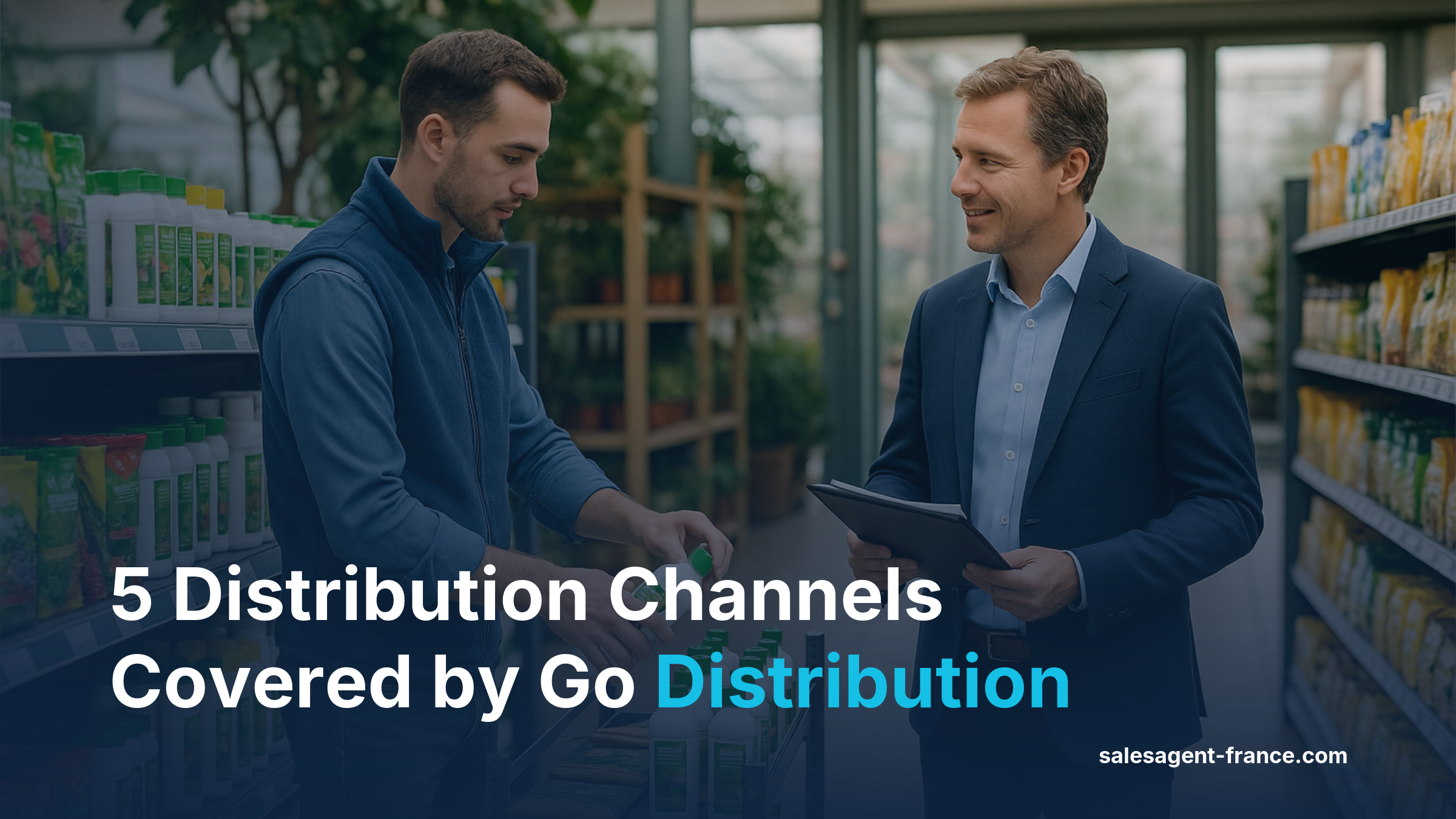
The short answer: they visit points of sale, build relationships with department managers, secure shelf space for your products and make sure nothing goes wrong once your range is listed. At Go Distribution, our six field agents collectively cover around 1,700 points of sale across five distribution channels:
- Garden centres (from independent specialists to Gamm Vert and Jardiland affiliates)
- DIY superstores such as Leroy Merlin, Castorama, Brico Dépôt and Bricomarché
- Builders’ merchants including Gedimat, Tout Faire and Chausson Matériaux
- Industrial supply distributors: Setin, Foussier, Legallais, Trenois Decamps, Prolians
- Independent hardware stores and quincailleries
Beyond prospecting and listing new products, a field agent manages in-store product demonstrations, monitors stock levels, trains counter staff and reports back to the manufacturer on competitor activity and pricing. That last point — structured field reporting — is something many manufacturers underestimate until they try to enter a new territory blind.
Why focus on the South of France rather than working with a national agency?
National coverage sounds appealing on paper. In practice, it often means a salesperson visiting your key accounts once or twice a year with a catalogue full of competing products. Regional concentration produces better results because relationships with department managers and purchasing contacts are built on frequency and familiarity, not grand promises.
The southern arc from Bayonne to Marseille has its own commercial logic. Garden centres in Occitanie sell very different volumes of irrigation and outdoor living products compared with their counterparts in Normandy. Builders’ merchants in the PACA region serve a construction sector that runs almost year-round, creating steady demand for fixings, tools and PPE lines from brands such as SPIT and Difac. A regional agency that lives and breathes this territory notices these differences and adjusts the commercial approach accordingly.
There is also the question of network density. According to market data reported by Geoptis (2025), the French DIY superstore estate reached roughly 21.8 billion euros in annual turnover in 2025, and the number of stores continues to grow even as the market softens. Industrial supply networks such as Prolians and Legallais maintain strong branch coverage across the South. An agent already embedded in these networks saves you months of cold prospecting.
How do French distribution channels differ from what I am used to at home?
The first thing to grasp is that listing a product and selling a product are two entirely separate events in French retail. Central buying offices (known as centrales d’achats) negotiate framework agreements, but day-to-day sell-through depends entirely on what happens at store level: shelf positioning, facing, pricing compliance and staff knowledge. The US Commercial Service (trade.gov, 2024) notes that introducing products via local field contacts remains one of the most reliable distribution methods in France precisely because of this gap between national listing and local execution.
The second difference is the role of independent networks. Chains such as Bricomarché and Mr.Bricolage operate under a franchise or cooperative model, which means individual store managers retain genuine buying autonomy for certain product categories. The same is true of many Gedimat and Tout Faire builders’ merchant outlets. Reaching these accounts requires a salesperson who already has a personal relationship with the buyer — which is exactly what a multi-brand agency provides from day one.
Thirdly, seasonality varies sharply by channel. Garden centres push hard from February to June, then again in autumn. DIY superstores see summer spikes in outdoor and fixings categories. Industrial supply branches run at a steadier pace but require regular technical visits. An experienced regional agent manages these rhythms without you having to think about them.
What types of products work well through a regional sales agent in the South of France?
Go Distribution’s current portfolio gives a clear picture of what fits. The agency represents brands across fixings (SPIT), security (Master Lock, Mottez), cutting tools (Alpha Coupe), PPE (Difac), stapling and nailing (Rapid) and sanitary innovation (Boku Japanese-style toilets). What these ranges share is that they benefit from face-to-face commercial support: a demonstration, an explanation of a technical specification, or simply a well-organised shelf that catches the eye of a professional buyer.
More broadly, the product categories that perform well through field agents in these networks include:
- Fixings, anchors and fasteners for builders’ merchants and industrial supply
- Hand tools, cutting tools and power-tool accessories for DIY superstores
- Security and access-control products (padlocks, chains, alarms) across all channels
- PPE and workwear for industrial supply and builders’ merchants
- Seasonal garden and outdoor living lines for garden centres
- Storage and organisation products for DIY superstores and hardware stores
Products that are purely commodity or that compete solely on price tend to be harder to place, because the value an agent brings — product knowledge, demonstration, category advice — is less relevant when a buyer’s only question is the unit cost.

How does the exclusive distribution mandate work, and what does it commit me to?
An exclusive distribution mandate is a commercial agency agreement under French law (loi Hoguet and the French Code de Commerce govern commercial agent relationships). In practical terms, it means Go Distribution is your sole representative for a defined territory — in this case, the 31 départements from Bayonne to Marseille — and you commit to routing all orders from that territory through the agency. You retain full control of your pricing policy, your product range decisions and your brand guidelines.
The key benefit for a manufacturer is predictability: one point of contact, one commission structure, and one coherent commercial voice in front of all the buyers in the territory. There is no risk of competing sales teams undercutting each other or giving inconsistent messages to the same chain. The agency earns its commission on confirmed orders, so its interests are directly aligned with yours.
Before signing, it is worth discussing which channels are in scope. Go Distribution can cover all five of its networks — garden centres, DIY superstores, builders’ merchants, industrial supply and hardware stores — or focus on the two or three channels where your product has the strongest fit. Starting focused and expanding the scope as volumes grow is usually the most sensible approach for a manufacturer entering the French market for the first time. You can find more detail on the agency model and its advantages on the Go Distribution advantages page.
What results can I realistically expect, and over what timeframe?
Honest answer: the first three to six months are about prospecting, sampling and negotiating initial listings. Do not expect significant order volumes in that period. What you should expect is a clear picture of which accounts are interested, which chains require a central-office reference before a local listing is possible, and where your product sits in relation to the competition on the shelf.
From month six onwards, well-placed products in active accounts typically show consistent reorder patterns, especially if the agent is conducting regular visits and flagging any out-of-stock or facing issues promptly. Manufacturers who support the process with good merchandising tools — shelf-ready packaging, clear planogram advice, point-of-sale materials — see faster velocity than those who deliver a pallet and disappear.
Go Distribution also offers structured market reporting, which means you receive regular visibility on which accounts are performing, which competitors are gaining space and where the next opportunity lies. That intelligence is genuinely useful for product development and pricing decisions back at your factory, wherever in France or Europe you are based. For a broader view of what the different missions of a commercial agent cover, the agency’s blog sets it out clearly.
You are looking to grow sales in the South of France?
Go Distribution places your ranges in garden centres, DIY superstores, builders’ merchants, industrial supply and hardware stores — 30 years of field experience across 31 départements from Bayonne to Marseille.
Conclusion
Choosing a regional sales agent in the South of France is not simply a matter of finding someone to make calls on your behalf. It is a decision about who represents your brand in front of buyers who see dozens of suppliers every month. Experience in the specific channels, existing relationships with department managers and a rigorous reporting process are what separate a productive agency partnership from a frustrating one. If your products belong in garden centres, DIY superstores, builders’ merchants, industrial supply or hardware stores between Bayonne and Marseille, get in touch with Go Distribution and we will tell you candidly whether there is a fit.
Frequently asked questions
Can a regional agent also handle product demonstrations and in-store animations?
Yes. Go Distribution runs in-store demonstration and animation programmes as part of its service offer. These are particularly effective at launch, when end-users and store staff need to see a product working before they will recommend it or reorder it confidently.
Does Go Distribution work with manufacturers based outside France?
Absolutely. The agency regularly works with European manufacturers — from Germany, Italy, Spain and elsewhere — who want to develop sales in southern France without opening a local subsidiary. The exclusive mandate model is straightforward to set up under French commercial law.
How many sales visits per year can I expect per point of sale?
Visit frequency depends on the channel and the account size. Key accounts in DIY superstores and industrial supply branches typically receive visits every four to six weeks. Smaller hardware stores may be visited quarterly. The agency calibrates its call cycle to the commercial potential of each outlet, not to a fixed schedule that treats all accounts the same.
