



How to Find a Commercial Agent to Sell Your Products in France

Finding a commercial agent to sell your products in France is one of the most practical decisions a manufacturer can make when entering the French market. The country’s retail and trade networks are fragmented, relationship-driven and demanding — without a local presence, even strong product ranges struggle to gain traction. This article answers the questions we hear most often from French and European industrialists who want to distribute through garden centres, DIY superstores, builders’ merchants, industrial supplies distributors and hardware stores.
What exactly does a commercial agent do in France?
A French commercial agent (agent commercial) is an independent professional, registered at the Registre Spécial des Agents Commerciaux (RSAC), who negotiates and concludes orders on your behalf under a written mandate (Articles L.134-1 et seq. of the French Commercial Code). Crucially, they are not an employee: they carry no fixed salary cost for you, and their remuneration is commission-based, tied directly to the turnover they generate.
In practice this means the agent visits distributors on regular call cycles, presents your catalogue, secures orders and handles the commercial relationship day to day. At Go Distribution we also carry out in-store demonstrations, planogram reviews, seasonal range updates and competitive reporting — all activities that are invisible from a head office but decisive on the shop floor.
The multi-line model (agent multicarte) is the most common structure: the agent represents several complementary, non-competing brands simultaneously. For a buyer at a hardware store or builders’ merchant, this is efficient — one visit covers several product categories. For you as a manufacturer, it means your agent already has a relationship with the buyer before your first sample even arrives.

Which distribution channels can a French commercial agent access?
France’s trade network is divided into distinct channels, each with its own buyers, listing procedures and field dynamics. A well-established agent will cover several of them in parallel:
- Garden centres: seasonal purchasing cycles, strong regional variation, emphasis on display and in-store theatre. Brands such as Master Lock and Mottez perform well here alongside garden-specific ranges.
- DIY superstores (grandes surfaces de bricolage): a powerful, concentrated channel — the French DIY superstore market reached approximately €22.1 billion in revenue in 2024 according to FMB and Inoha. Major chains negotiate centrally but demand store-level follow-up from field agents.
- Builders’ merchants (négoces de matériaux): groups such as Gedimat, Tout Faire Matériaux and Chausson Matériaux operate through regional or branch-level purchasing. Counter staff advise tradespeople directly, so product training is essential. Fixings brands like SPIT are a natural fit here.
- Industrial supplies distributors: networks such as Setin, Foussier, Legallais, Trenois Decamps and Prolians serve professional buyers who expect technical depth and reliable stock. PPE ranges like Difac find their core audience in this channel.
- Hardware stores (quincailleries): a mix of independent family-run outlets and buying groups. These stores reward loyalty and consistency; a manufacturer who shows up regularly — not just at launch — earns a durable position on the shelf.
Go Distribution covers all five channels across 31 départements in the South of France, from Bayonne to Marseille, spanning Nouvelle-Aquitaine, Occitanie and PACA. Our six field agents visit approximately 1,700 points of sale on regular call cycles. See how we approach commercial representation in the DIY and hardware sector for more detail on the channel mechanics.
How is a distribution mandate structured in France?
The agency agreement — or mandat de distribution — must be set out in writing and cover four key points: the geographic territory, the product ranges included, the commission rate, and the duration with termination notice provisions. French law (Article L.134-12 of the Commercial Code) grants the agent a compensatory indemnity if the principal terminates the contract without cause, so the drafting matters for both sides.
An exclusive mandate is the arrangement we work with at Go Distribution. Exclusivity over a defined territory gives the agent the commercial confidence to invest time in your range without risk of being undercut by a parallel channel. For you as a manufacturer, it also means a single point of accountability: one partner, one reporting line, one territory.
Commission rates vary by channel and product category, typically ranging between 5% and 15% of net invoiced sales. There is no fixed salary outgoing for you until an order is placed — making the model low-risk for market entry. For a broader look at the advantages of this structure, our article on the advantages of using a commercial agent goes deeper into the cost comparison with a salaried sales force.
What should you look for when choosing a commercial agent in France?
Not all agents are equal, and sector fit matters more than geography alone. Here are the criteria that count:
- Existing relationships in your target channels: an agent who already calls on Legallais or Gedimat can place your range on the next visit rather than starting cold.
- A complementary, non-competing portfolio: the agent’s existing mandates should sit alongside yours, not compete with them. At Go Distribution, the portfolio spans fixings (SPIT), stapling (Rapid), cutting tools (Alpha Coupe), security (Mottez, Master Lock), PPE (Difac) and bathroom equipment (Boku) — ranges that open doors across multiple channels without conflict.
- Field density and call frequency: how many points of sale does the agent visit, and how often? A large territory covered thinly is worth less than a focused zone visited regularly.
- Reporting discipline: you should receive structured feedback after each campaign — what was listed, what was refused, what competitors are doing. This is market intelligence you cannot buy elsewhere.
- Track record with similar product families: ask for concrete examples. How did they introduce a new fixing range into a builders’ merchant group? How did they manage a planogram renegotiation in a DIY superstore?
You can find more detail on what the agent’s day-to-day role involves in our article on the different missions of a commercial agent.
How long before you see results from a French commercial agent?
Realistic timelines depend on the channel. Garden centres and hardware stores can move quickly — if your product fits a gap and the agent has a strong relationship with the buyer, a first listing can come within six to eight weeks of the mandate being signed. Builders’ merchant groups and industrial supplies networks tend to work on longer purchasing cycles, with range reviews often tied to annual or bi-annual meetings.
In-store visibility follows the listing. Once a product is referenced, the agent’s subsequent visits monitor stock levels, correct facing issues, organise promotional placements and train counter staff. This is where the real sell-through happens. A listing without field follow-up is a wasted opportunity — a truth every channel manager at Gedimat, Prolians or Tout Faire Matériaux would confirm.
Go Distribution has been running this cycle since 1994. When we took on the Alpha Coupe cutting tools range, for instance, the priority was not just to get the reference into the system but to ensure the product was understood and recommended at counter level — which requires physical visits, not emails.
Is externalising your French sales force the right move for your business?
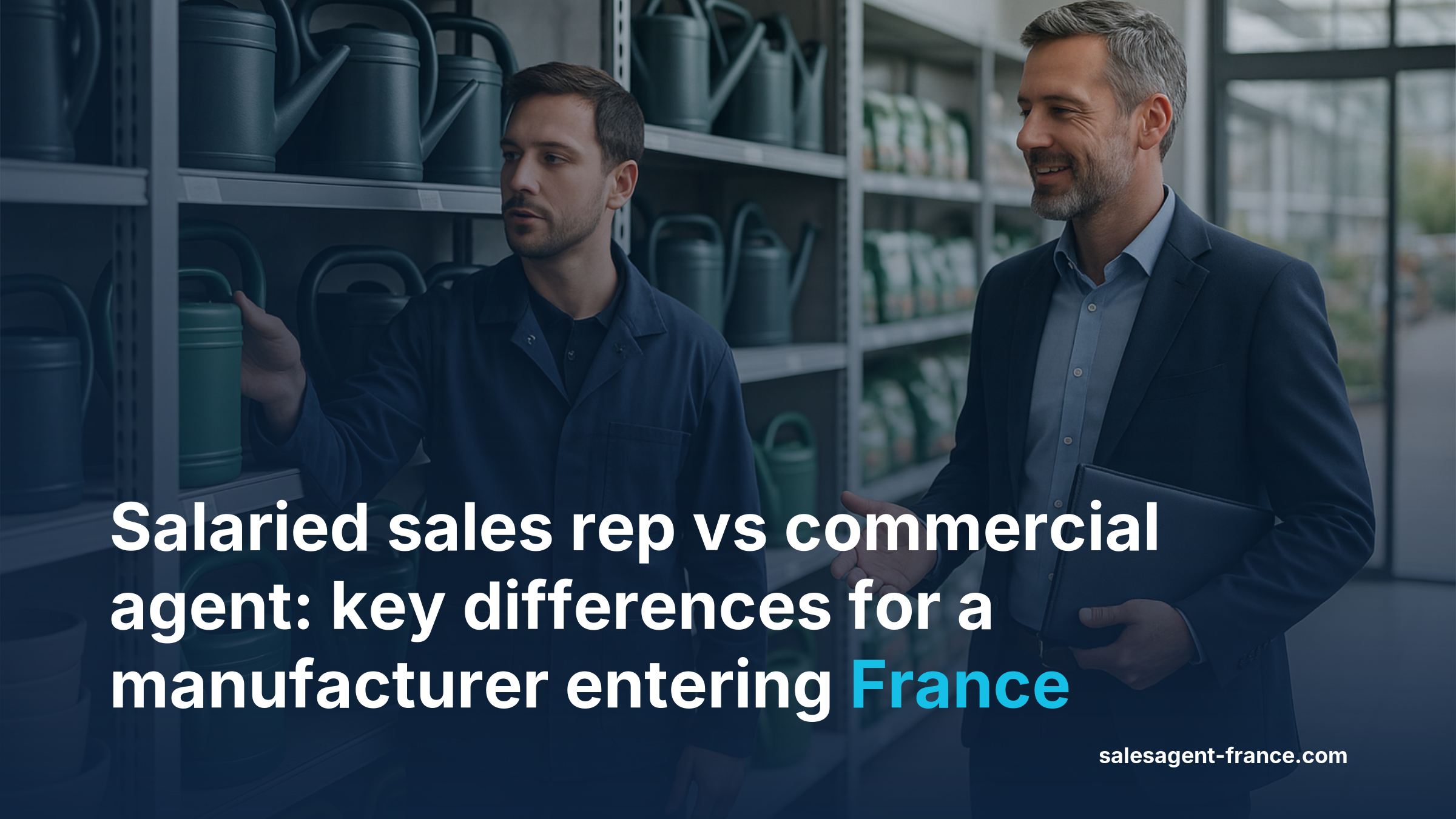
For most manufacturers entering France — whether French SMEs or European industrialists — the question is not whether to have a field presence, but whether to build one from scratch or partner with an established structure. Building a proprietary salaried sales team in France involves recruitment costs, on-costs, management overhead and a cold-start period of at least twelve to eighteen months before the rep has meaningful relationships in the market.
An experienced multi-line agency removes the cold-start entirely. Your range enters a network of existing distributor relationships from day one. The commission model also means your commercial cost scales directly with your revenue: no fixed charges during a slow season, no redundancy risk if you decide to exit a channel.
That said, externalisation works best when the manufacturer stays involved: sharing product training, attending key account meetings alongside the agent, and co-investing in promotional materials. The agent brings the network; you bring the product expertise. Together, that combination is difficult for a competitor to replicate. Read more about the full rationale in our piece on why manufacturers externalise their sales force.
You want to distribute your products in France?
Go Distribution places your ranges in garden centres, DIY superstores, builders’ merchants, industrial supplies and hardware stores — 30 years in the field across the South of France.
Frequently asked questions
Can a commercial agent represent my brand exclusively in France without covering the whole country?
Yes. The mandate defines the territory, and it is entirely legitimate to begin with a region — such as the South of France — before extending coverage. Many manufacturers start with one geographic zone to validate their commercial model before rolling out nationally. Regional exclusivity still gives the agent the commitment needed to invest in your range.
What documentation do I need to appoint a commercial agent in France?
French law requires a written mandate (contrat d’agent commercial) specifying the territory, product scope, commission rate and notice periods. Both parties should also agree on reporting frequency and format. It is advisable to have the contract reviewed by a lawyer familiar with French commercial law, particularly regarding the compensatory indemnity provisions under Article L.134-12 of the Commercial Code.
Does Go Distribution work with manufacturers outside France?
Yes. We work with both French industrialists and European manufacturers who want to reach French distributors across the South of the country. The mandate is signed in French, but the commercial relationship is straightforward to manage from abroad — we handle all day-to-day distributor contact, and you receive regular structured reporting on your range’s performance.
If you are considering entering the French market or strengthening your presence in the South, the first step is a direct conversation about your product range, your target channels and the territory that makes sense for your business. Contact Go Distribution and we will give you an honest assessment of what is achievable and on what timeline.
