



French DIY Market Trends: Key Figures & Outlook for Manufacturers

The French DIY market is one of the largest in Europe, yet it is currently going through a genuine reset. After the exceptional surge of 2020–2021, the sector has contracted for two consecutive years, and understanding exactly what is happening — channel by channel, category by category — is essential for any manufacturer considering distribution in France. At Go Distribution, we operate across all five specialist channels every single week, and the picture on the ground is considerably more nuanced than the headline numbers suggest.
Why These Market Trends Matter for Manufacturers
France ranks third in Europe for DIY retail, behind Germany and the United Kingdom (Businesscoot, 2025). The French home-improvement ecosystem is vast and structurally complex: three dominant retail groups — Adéo (Leroy Merlin, Weldom, Bricoman), Kingfisher (Castorama, Brico Dépôt) and Les Mousquetaires (Bricomarché, Brico Cash) — together control roughly 90% of DIY superstore turnover. Add specialist garden centres, builders’ merchants such as Gedimat, Tout Faire and Chausson Matériaux, plus the industrial supply networks (Setin, Foussier, Legallais, Trenois Decamps, Prolians) and independent ironmongers, and you have a deeply fragmented landscape where local expertise is not optional — it is decisive.
For a manufacturer without an established French commercial presence, reading these trends in the abstract is not enough. You need to know which channels are resilient, which categories are moving and which buyers are actually placing orders. That is the intelligence a field-based commercial agency brings, built from 30 years of weekly visits across the South of France.
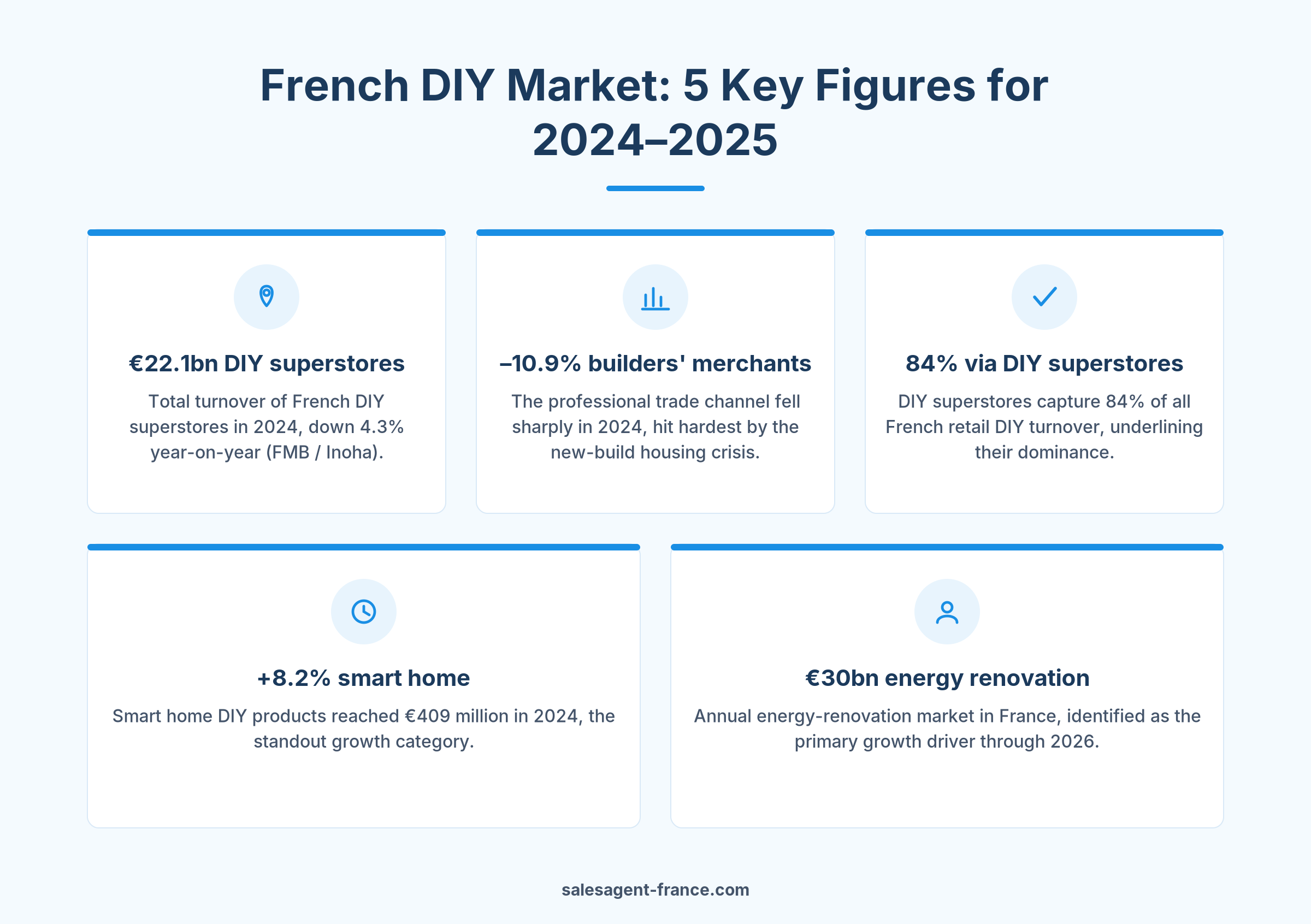
The stakes are higher than ever: the professional trade channel (builders’ merchants and industrial supply) fell by –10.9% in 2024 according to FMB and Inoha data, while DIY superstores recorded a more contained –4.3% on a turnover of €22.1 billion. These are not symmetric risks — knowing which basket to place your range in can make or break a market-entry strategy.
How to Read the French DIY Market: A Step-by-Step Method
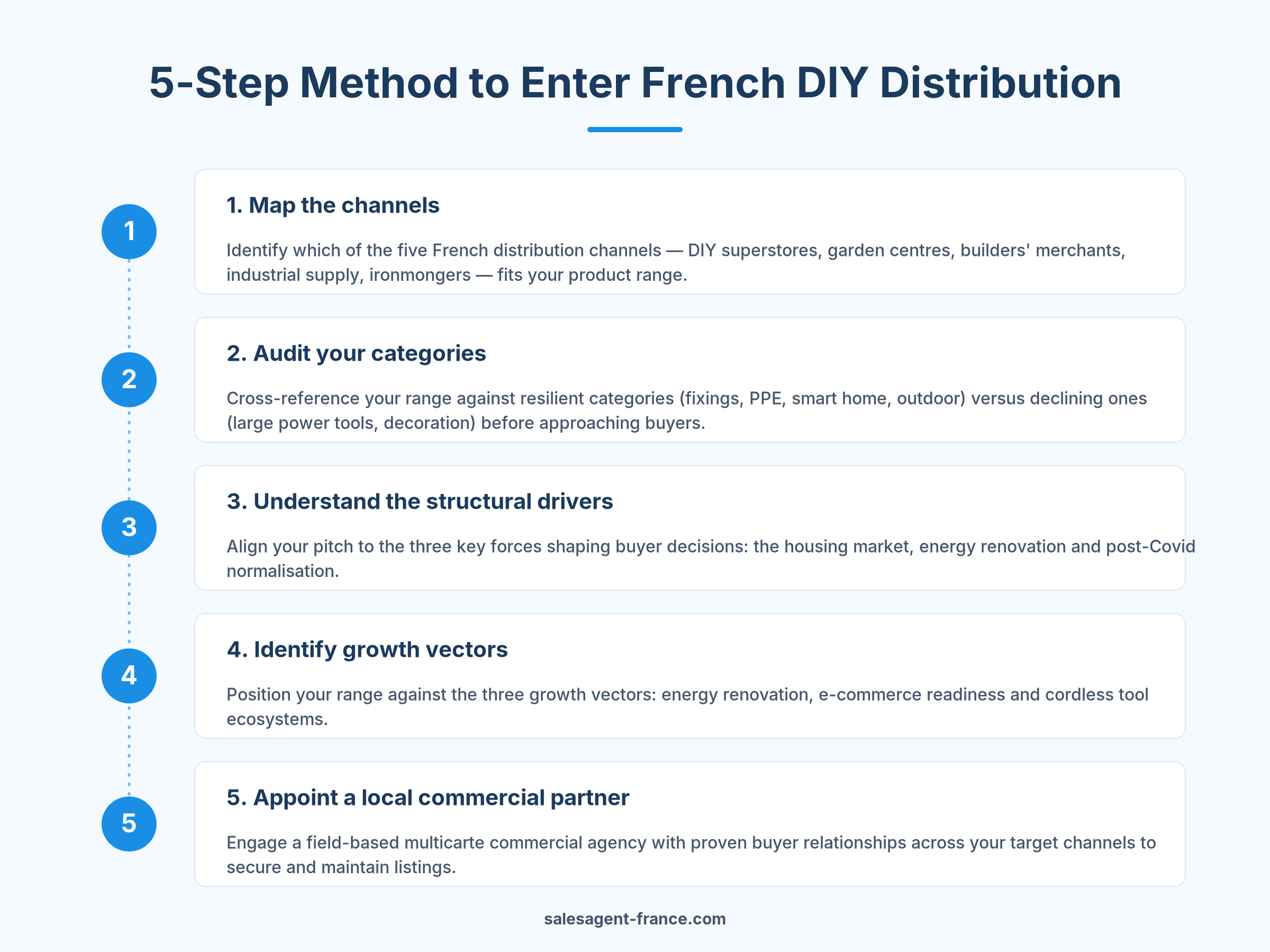
Step 1 — Map the five distribution channels and their current dynamics
France has five distinct specialist channels, each with its own buying rhythm, margin expectations and category logic. DIY superstores (grandes surfaces de bricolage) represent approximately 75–84% of retail DIY turnover and remain the gravitational centre of the market, despite two consecutive years of decline. Garden centres (jardineries) lost ground in the garden category in 2024 (–4.9% overall according to NielsenIQ GfK), with DIY superstores actually gaining market share in garden, reaching 32.1% of garden sales.
The builders’ merchant and materials trade channel suffered the sharpest fall (–10.9% in 2024), dragged down by the collapse in new-build housing — France is projected to complete fewer than 300,000 homes in 2026 against a structural need of around 400,000 (PRISMEFIX / Fastener & Fixing Magazine, 2026). Industrial supply networks and specialist ironmongers, by contrast, show greater resilience on consumables: fixings, fasteners, PPE and cutting tools tend to be driven by maintenance budgets rather than project spend, which makes them less cyclical.
Step 2 — Identify the resilient and declining product categories
Not all categories are suffering equally. Within DIY superstores in 2024, the steepest declines were recorded in:
- Power tools: –16.7% (IntoTheMinds, 2025)
- DIY and decoration: –21.1%
- Lighting: –6.4%
- Traditional gardening: –5.9%
Meanwhile, categories that held up or grew include:
- DIY accessories and fixings materials: +1.6%
- Plants and seeds: +0.7%
- Outdoor fittings and camping: +2.2%
- Smart home products: +8.2%, reaching €409 million (NielsenIQ GfK, 2024)
From our daily work alongside buyers for brands such as SPIT (fixing systems), Master Lock (security) and Alpha Coupe (cutting tools), we see precisely this pattern: consumable, maintenance-driven and safety-related ranges hold their ground even in a soft market. Big-ticket power tools stall when consumer confidence dips.
Step 3 — Assess the structural drivers behind the correction
Three structural factors explain the 2023–2025 correction, and manufacturers need to understand them to pitch credibly to French buyers:
- The housing market freeze: fewer property transactions means fewer renovation projects. French residential property hit a low point in late 2024, with only around one million transactions recorded on a rolling 12-month basis (Inoha data, 2024).
- Purchasing-power pressure: between 27% and 29% of French consumers reported delaying or cancelling home-improvement projects in 2024 due to the economic context (IntoTheMinds, 2025). Some 75% of DIY practitioners used equipment that was over a year old.
- Post-Covid normalisation: the market remains around 13% above its 2019 baseline, so the correction is best understood as a return to trend rather than structural decline.
Step 4 — Spot the growth vectors for the next cycle
Even in a contracting market, forward-looking manufacturers can identify where the next buying cycle will emerge. Three vectors are clearly signposted:
- Energy renovation: this segment represents an annual market estimated at €30 billion (IntoTheMinds, 2025). Government incentive schemes are pushing households and landlords towards insulation, ventilation and heat-pump products — categories where fixings, EPI and specialist tools are essential companions.
- E-commerce: online sales across the broader home-improvement market grew by +6% in 2024 even as physical stores fell. Within DIY superstores alone, online already accounts for around 5.6% of turnover, with click-and-collect representing 63% of digital orders. A manufacturer entering France today must have a compliant digital asset pack ready.
- Cordless electrification: cordless power tools bucked the general tools trend, jumping +19% in 2024 (Businesscoot, 2025). Categories adjacent to battery-platform ecosystems — fixings, blades, accessories — benefit from this pull-through effect.
Step 5 — Choose the right local commercial partner for each channel
This is where strategy meets execution. A manufacturer can read every market report available and still fail at referencing if it approaches buyers without a local commercial presence. French DIY superstore and garden-centre buyers operate on tight category review calendars; builders’ merchants like Gedimat or Chausson Matériaux conduct centralised negotiations but expect regional follow-through; industrial supply networks such as Legallais or Trenois Decamps have their own technical sales processes.
A multicarte commercial agency with active coverage of these channels — visiting stores, running in-store demonstrations, tracking competitor shelf allocation and feeding back sell-out data — is the most cost-effective way to build and maintain listings. It is precisely the model Go Distribution has operated since 1994 across 31 departments, from Bayonne to Marseille. You can read more about how this model works on our page dedicated to commercial agents for DIY and home improvement.
What Manufacturers Gain by Acting Now
Counter-intuitive as it may seem, a market correction is often the best moment to gain shelf space. When volumes fall, buyers reassess their range architecture: weaker references are delisted, and well-positioned newcomers can negotiate entry on better terms than during a boom. We have seen this pattern play out with brands in our own portfolio — manufacturers who approached buyers during the 2023–2024 softening secured listings that would have been far harder to obtain in 2021.
Three measurable benefits emerge from moving during a correction:
- Faster category reviews: buyers under pressure to rebuild margin are more receptive to innovative or better-priced alternatives from European manufacturers.
- Lower promotional investment required at launch: with less foot traffic, in-store demonstrations — a core service at Go Distribution — deliver a higher share of voice for your brand relative to competitors.
- Loyalty built on fundamentals: brands that support buyers through a difficult period with reliable stock, compliant labelling and consistent sell-through data earn durable listing positions when the market recovers. Our experience with partners such as Rapid, Difac (PPE) and Mottez shows that channel relationships built in lean years tend to be the stickiest.
For manufacturers considering externalising their commercial force in France, the financial logic is also compelling: the total cost of a salaried field representative in France — salary, social charges, vehicle, tools — typically exceeds €70,000–€80,000 per year before any commercial result is achieved. A commission-based agency arrangement aligns costs directly with revenue from day one.
Questions fréquentes
Is the French DIY market expected to recover in 2026 and beyond?
Industry bodies forecast stabilisation rather than a sharp rebound in 2026, with the home-improvement market estimated at around €32.5 billion across all channels and declining a further –2.7% in 2025 before plateauing (PRISMEFIX / Fastener & Fixing Magazine, 2026). The medium-term outlook is cautiously positive, underpinned by energy-renovation demand and household maintenance spend, which are structurally non-deferrable.
Which distribution channel is most accessible for a new manufacturer entering France?
There is no universal answer — it depends on your product category and margin structure. DIY superstores offer the greatest volume but require significant investment in trade marketing and logistics compliance. Industrial supply networks (Setin, Foussier, Prolians…) can be faster to penetrate for technical products such as fixings, PPE or cutting tools, and tend to work on longer-term partnership models. A realistic assessment of your range, your production capacity and your target end-user should drive channel selection before any buyer approach.
Do French buyers expect a local point of contact, or can manufacturers manage from abroad?
In our experience, a local point of contact is not a nice-to-have — it is a prerequisite for maintaining a listing over time. Buyers at Gedimat, Tout Faire, Legallais or independent ironmongers all expect regular visits, rapid responses to shelf issues and proactive category input. Manufacturers who rely solely on remote contact from their home country consistently lose listings to competitors with a physical commercial presence in France. This is the core value proposition of working with an established multicarte commercial agent.
Vous cherchez à distribuer vos produits en France ?
Go Distribution places your ranges in garden centres, DIY superstores, builders’ merchants, industrial supply networks and ironmongers — 30 years of field expertise across the South of France.
Conclusion
The French DIY and home-improvement market is not in crisis — it is recalibrating. The headline decline of –4.3% for DIY superstores in 2024 (FMB / Inoha) masks very real pockets of resilience: fixings and accessories, smart home products, energy-renovation-adjacent categories and the industrial supply channel. For a European or French manufacturer with the right range and the right go-to-market approach, the current environment presents genuine entry opportunities that a full market will not offer again for several years. If you would like a frank conversation about where your products fit in the French distribution landscape, our team is available at Go Distribution.
