



Finding a Sales Agent in the South of France for Your Products
Finding a sales agent in the South of France is often the first real obstacle a European or French manufacturer faces when trying to build a distribution footprint across Occitanie, PACA and Nouvelle-Aquitaine. The region stretches from Bayonne to Marseille, spans 31 départements, and hosts a dense patchwork of garden centres, DIY superstores, builders’ merchants, industrial supply distributors and independent hardware stores — each with its own purchasing logic, its own key contacts and its own seasonal rhythms. Getting it wrong at the start costs time that most commercial teams simply cannot afford.
The real difficulties of entering French specialist retail from outside
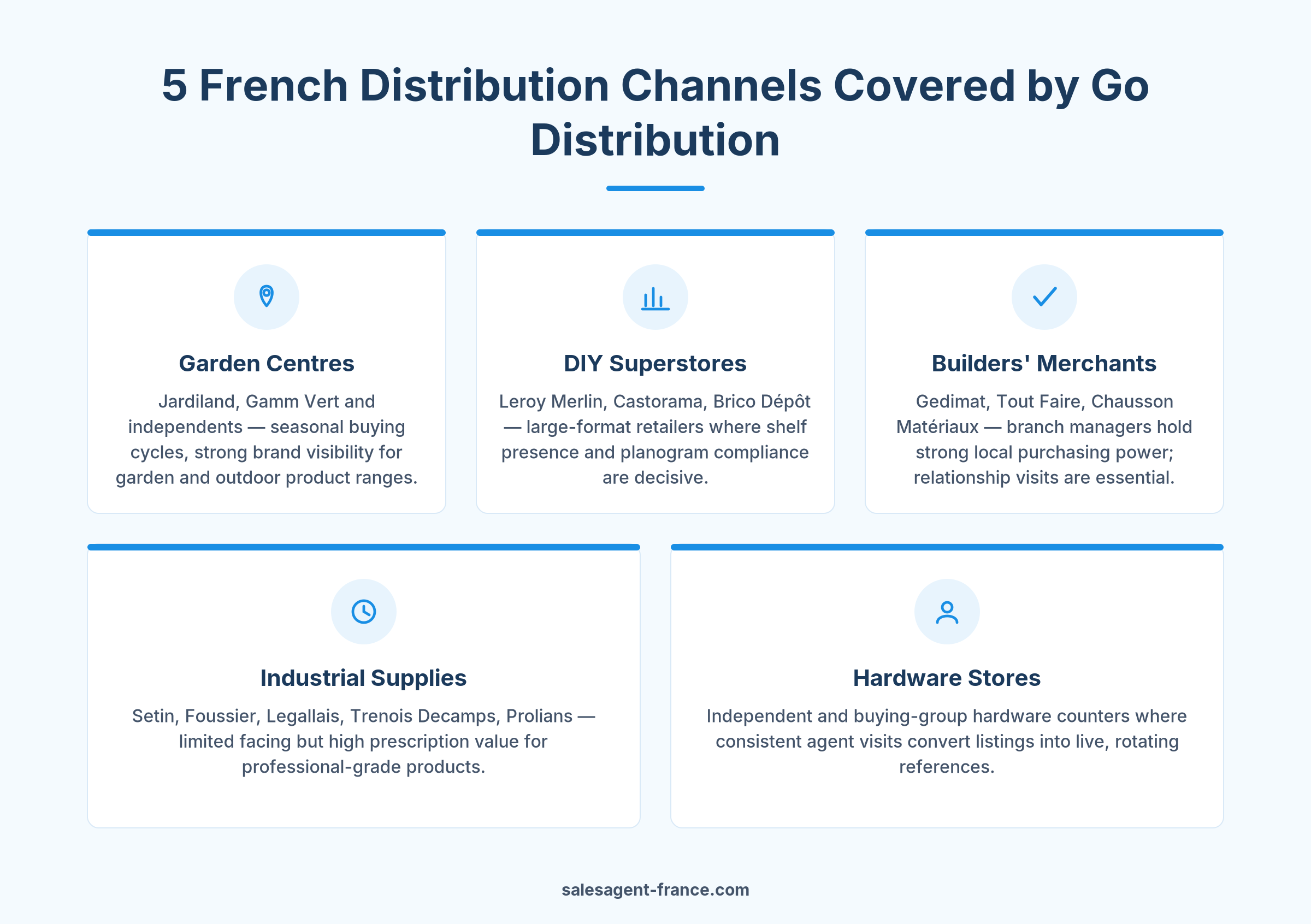
The first difficulty is one of geography. The South of France is not a single market: a buyers’ meeting at a Gedimat branch in Toulouse bears little resemblance to a shelf negotiation at a Prolians counter in Aix-en-Provence. Each channel — garden centres, DIY superstores (grandes surfaces de bricolage), builders’ merchants, industrial supplies, hardware stores — has its own procurement cycle, its own planogram logic and its own face-to-face culture. A manufacturer relying on a national sales director based in Paris to cover these 31 départements remotely will quickly find that visit frequency drops, shelf space shrinks and reorders stall.
The second difficulty is relational. In builders’ merchant networks such as Gedimat, Tout Faire or Chausson Matériaux, the branch manager holds significant local purchasing power. In industrial supply chains — Setin, Foussier, Legallais, Trenois Decamps, Prolians — facing space is limited but in-counter prescription is everything. In both cases, the person standing in front of the buyer matters more than any central listing. An unknown face, however well-prepared, rarely converts on a first visit.
What happens when the wrong commercial structure is in place
Many manufacturers try to solve the coverage problem by appointing a single freelance agent or by asking an existing logistics partner to “push” the range. In practice, neither works well. A lone agent covering the whole South of France cannot physically maintain the visit frequency that garden centres and DIY superstores demand — particularly around peak seasons (spring for garden, autumn for fixings and PPE). Orders slip through the gaps, and the brand loses shelf presence to better-visited competitors.
The cost of a salaried sales representative compounds the problem. When salary, employer social charges, company vehicle, expenses and management time are totalled, a single field rep in the South of France typically costs a manufacturer well over €60,000 per year — before a single order is written. For a manufacturer testing a new channel or entering France for the first time, that fixed cost is a significant risk on an uncertain revenue base.
A third trap is underestimating the breadth of channels available. The French garden market alone was valued at around €3.1 billion in 2024 (Propulse by CA / Les Echos Études data), with DIY superstores, specialist garden centres and mass retail all competing for the same consumer. A manufacturer who focuses only on one channel leaves substantial turnover on the table — and often discovers too late that a competitor has already locked up the adjacent networks.
The multi-line commercial agency: how the model solves these problems
A multi-line commercial agency (agence commerciale multicarte) aggregates several complementary, non-competing mandates under one field team. Each agent visits the same points of sale on behalf of several manufacturers, which means the cost of the visit is shared — and the visit frequency can be maintained without any single principal bearing the full burden. This is the structural advantage that makes the model particularly efficient for specialist retail in France.
Go Distribution has operated this model since 1994. Six field agents cover approximately 1,700 points of sale across 31 départements, from Bayonne to Marseille. The team knows the buyers, the section managers and the branch heads by name — in Jardiland and Gamm Vert garden centres as much as in Leroy Merlin or Brico Dépôt DIY superstores, in independent hardware stores as much as in the Foussier or Legallais industrial supply counters. That relationship capital is not something a new entrant can replicate quickly.
The commission-only structure also changes the risk profile entirely for the manufacturer. As one of Go Distribution’s own pages notes, the agent is paid on commission on sales achieved — no fixed salary, no vehicle costs, no employer social charges. For a manufacturer entering a new territory or a new channel, the cost base only rises when revenue rises.
What a well-structured mandate looks like in practice
A distribution mandate with a multi-line agency in the South of France should define clearly:
- The channels covered (garden centres, DIY superstores, builders’ merchants, industrial supplies, hardware stores — or a subset);
- The geographic perimeter (which départements, which networks);
- The product ranges included in the mandate;
- Reporting frequency and format (weekly sell-out data, monthly visit reports, competitive shelf audits);
- The commission rate and any listing-support or animation budget.
In practice, Go Distribution often starts with one or two channels for a new principal, then extends the mandate once the first results validate the range positioning. Brands such as Rapid (stapling and fastening), SPIT (fixings), Mottez (security and towing), Master Lock, Difac (PPE) and Alpha Coupe (cutting tools) have followed this gradual, channel-by-channel approach across the South of France networks.
Point-of-sale animation is a natural extension of the agent’s role. Demonstrating a Boku Japanese toilet seat in a plumbing section, running a seasonal fixings promotion for SPIT in a DIY superstore, or organising a product training session for the counter staff at a Trenois Decamps branch — these are the actions that turn a listing into a live, rotating reference. They are also the actions that a remote or under-resourced commercial structure simply cannot sustain.
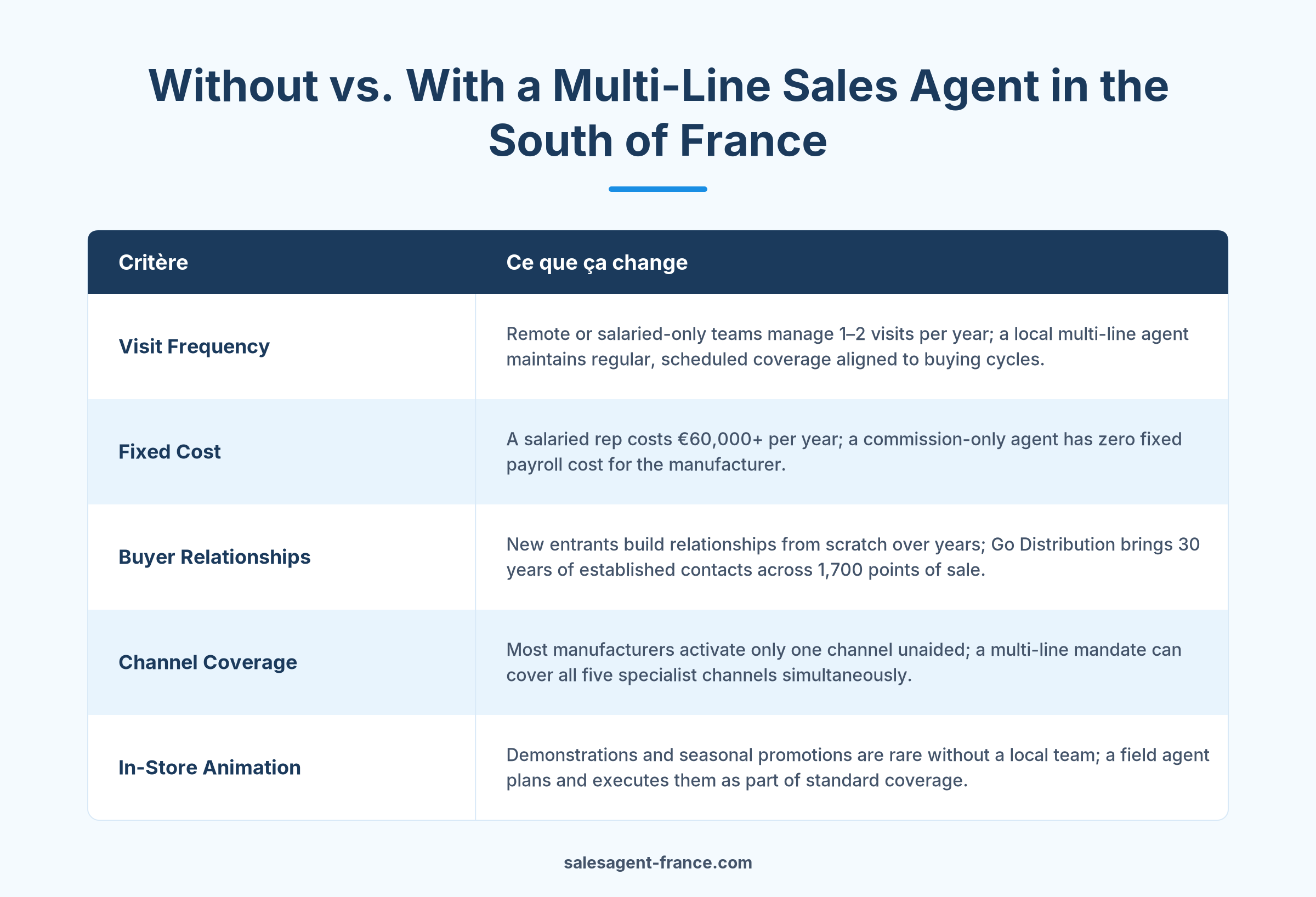
Before versus after: what changes when you appoint the right agent
| Situation | Without a local multi-line agent | With Go Distribution |
|---|---|---|
| Visit frequency | 1–2 visits per year per point of sale | Regular scheduled visits aligned to buying cycles |
| Fixed cost | €60,000+ per salaried rep per year | Commission on sales only — zero fixed payroll |
| Buyer relationships | Built from scratch, slow to establish | Existing relationships across 1,700 points of sale |
| Channel breadth | Typically 1 channel targeted | Up to 5 channels covered under one mandate |
| In-store animation | Rare, dependent on distributor goodwill | Planned demonstrations, seasonal promotions, training |
Looking to distribute your products in France?
Go Distribution places your ranges in garden centres, DIY superstores, builders’ merchants, industrial supplies and hardware stores — 30 years of field experience in the South of France.
Questions fréquentes
Does a multi-line agent conflict with our existing national distribution agreements?
Not necessarily. The mandate defines the geographic perimeter and the channels covered, so it can be scoped to complement — rather than overlap — any central purchasing agreements or existing national accounts you have already activated. Many manufacturers use a regional agent specifically to drive sell-out in areas where national listings are underperforming.
How long before we see the first results in the South of France networks?
The timeline depends on the channel. In builders’ merchants (Gedimat, Tout Faire, Chausson Matériaux) and industrial supply counters (Legallais, Prolians, Trenois Decamps), initial referencing can move quickly once the agent has a relationship with the branch manager. In garden centres and DIY superstores, buying cycles are more structured and the first full season is often the realistic benchmark for measuring traction.
What types of products are best suited to this model?
Product families with steady rotation work particularly well: fixings, hand and cutting tools, PPE, builders’ hardware, garden accessories and security products. These are the categories where Go Distribution’s current portfolio — Rapid, SPIT, Mottez, Difac, Master Lock, Alpha Coupe — already demonstrates the model’s effectiveness. Products requiring complex technical specification or very long sales cycles are generally better served by a dedicated internal team.
In summary
Entering French specialist retail without a structured local presence is a slow and costly path. The advantages of a multi-line commercial agent are most visible precisely in markets like the South of France, where the density of points of sale, the variety of channels and the importance of personal relationships make remote management impractical. If your products belong in garden centres, DIY superstores, builders’ merchants, industrial supply networks or hardware stores between Bayonne and Marseille, the most direct route is a conversation with a team that has been visiting those shelves every week for over 30 years. Get in touch with Go Distribution to discuss a mandate that fits your commercial ambitions.
