



What a Sales Agent Really Does in French Distribution Networks
A sales agent working in French distribution networks is far more than a person who takes orders and moves on. Over 30 years of daily work in DIY superstores, garden centres, builders’ merchants, industrial supply houses, and ironmongers across the South of France, the role has proved to be the single most decisive factor between a product range that survives on shelf and one that genuinely sells. Yet many manufacturers — particularly those entering the French market for the first time — still underestimate what this work involves, and pay the price in lost listings, slow reorders, and shelves that drift into disorder.
The Problem: Your Products Are Listed but Nobody Is Selling Them
Getting an initial reference with a DIY superstore buyer or a garden-centre purchasing group is a real achievement. The paperwork is signed, the first delivery arrives — and then, very often, nothing happens. The range sits on a shelf at the wrong height, the facing is too narrow, and the shelf tag no longer matches the current price. No one in the store has been briefed on the product. The category manager has moved on to the next season.
This is the most common problem reported by manufacturers who try to manage French retail distribution from a head office in Germany, Italy, or Belgium. The French distribution market is structured for regular, physical presence. According to NielsenIQ and GfK data published in February 2025, DIY and garden turnover in France fell by 2.7% in 2025 after a 6% drop in 2024, tightening margins across all channels. In a contracting market, buyers and category managers have even less time for suppliers who are not physically in front of them on a regular basis.
The consequences for an absent manufacturer are predictable:
- Reorders are delayed or forgotten.
- Competitor products fill the gaps on the shelf.
- Promotional slots go to better-organised brands.
- The initial listing is quietly delisted at the next range review.
The Difficulty: Five Channels, Each With Its Own Logic
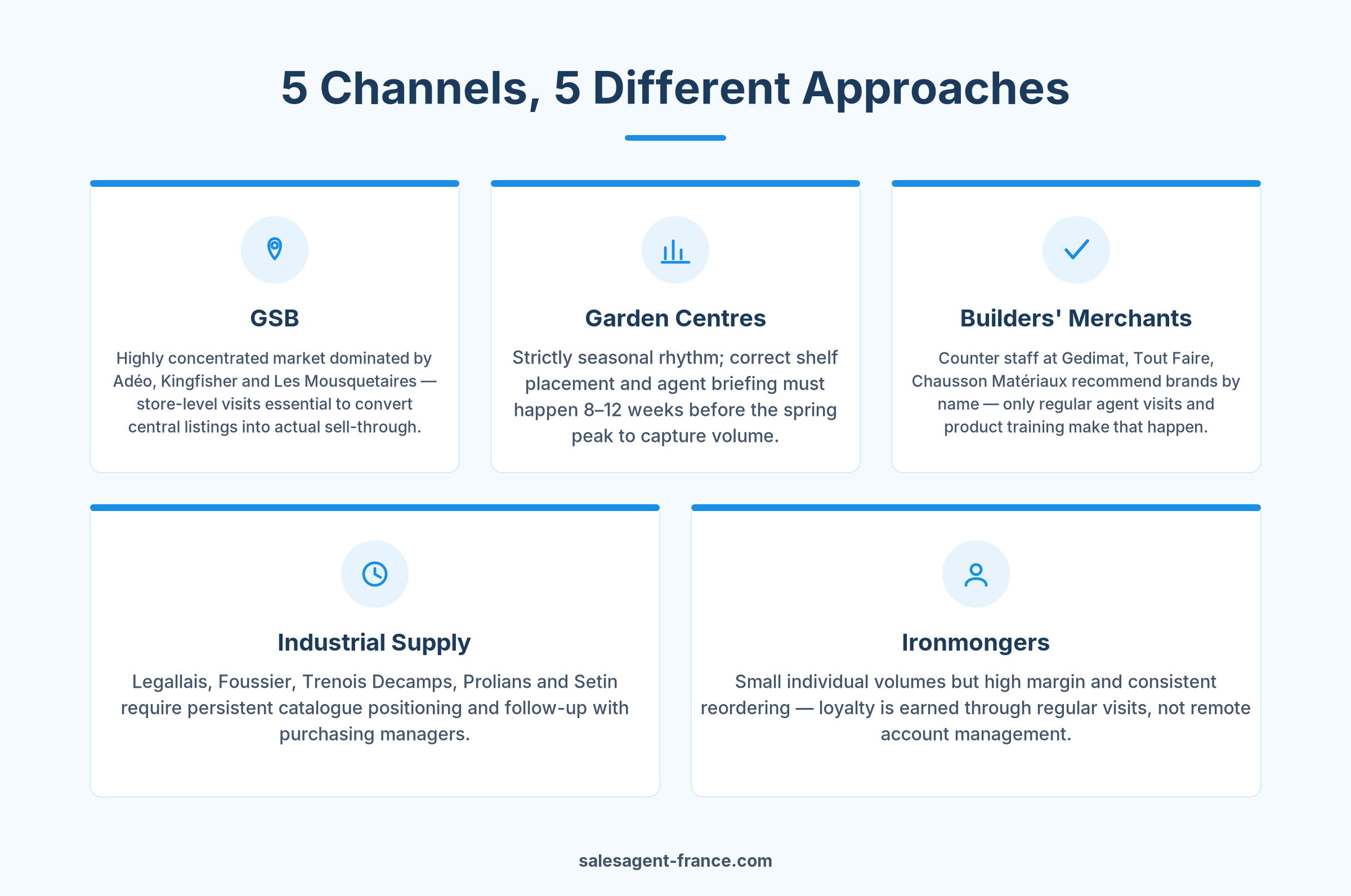
French retail distribution is not a single market — it is five distinct channels, each with its own purchasing culture, calendar, and decision-making structure. A manufacturer who treats them identically will struggle in all of them.
DIY superstores are highly concentrated: according to the FMB and INOHA 2025 study, the Adéo group (Leroy Merlin, Bricoman, Weldom) alone accounts for 50% of DIY superstore turnover, with Kingfisher (Castorama, Brico Dépôt) at 25% and Les Mousquetaires at 14.5%. Negotiating a central listing does not guarantee sell-through at store level — that still requires regular visits to department managers.
Garden centres and LISA operate on a strongly seasonal rhythm. A range of garden fixings or security products (such as Master Lock padlocks) must be on shelf and correctly merchandised before the spring upturn, not after. Miss the seasonal window and you lose twelve months of volume.
Builders’ merchants — Gedimat, Tout Faire Matériaux, Chausson Matériaux — work on long-term supplier loyalty. Their counter staff are technical advisers; they recommend brands by name to tradespeople. Without a sales agent visiting regularly and training the counter team on a fastening range like SPIT or a cutting-tools range like Alpha Coupe, that recommendation never happens.
Industrial supply houses — Setin, Foussier, Legallais, Trenois Decamps, Prolians — demand rigorous catalogue positioning and persistent follow-up with purchasing managers. An EPI range such as Difac personal protective equipment must be positioned correctly in the catalogue hierarchy; a single visit is not enough.
Ironmongers and independent hardware retailers are loyal to suppliers who visit them. They are small in individual volume but highly profitable per unit and remarkably consistent in reordering — provided someone keeps the relationship alive.
The Solution: What a Field Sales Agent Actually Does
A field sales agent operating across these five channels is not primarily an order-taker. The daily work breaks down into a set of concrete, repeated actions that compound over months and years into a brand’s market position.
On a typical week across the 31 departments covered by Go Distribution (from Bayonne to Marseille), an agent will:
- Visit a garden centre to check facing width, update price labels, and propose a promotional end-cap for the coming season.
- Call on a Gedimat branch to discuss a new fixing reference from the SPIT range, leave updated technical documentation, and record the reorder into the reporting system.
- Spend time with the PPE buyer at a Foussier branch, walking through the Difac catalogue to add two references that were missing from the local assortment.
- Attend a product demonstration at a Castorama store alongside the department manager, presenting a Rapid stapling solution to the floor team.
- Follow up by phone with a Trenois Decamps purchasing contact on a pending Master Lock security range proposal.
None of this is glamorous. All of it directly generates sell-through, reorders, and — critically — visibility at the moment of purchase. A product that is correctly positioned, well-lit, and understood by the sales assistant in front of the customer sells. One that is not, does not.
Before and After: What Changes When a Sales Agent Covers Your Range
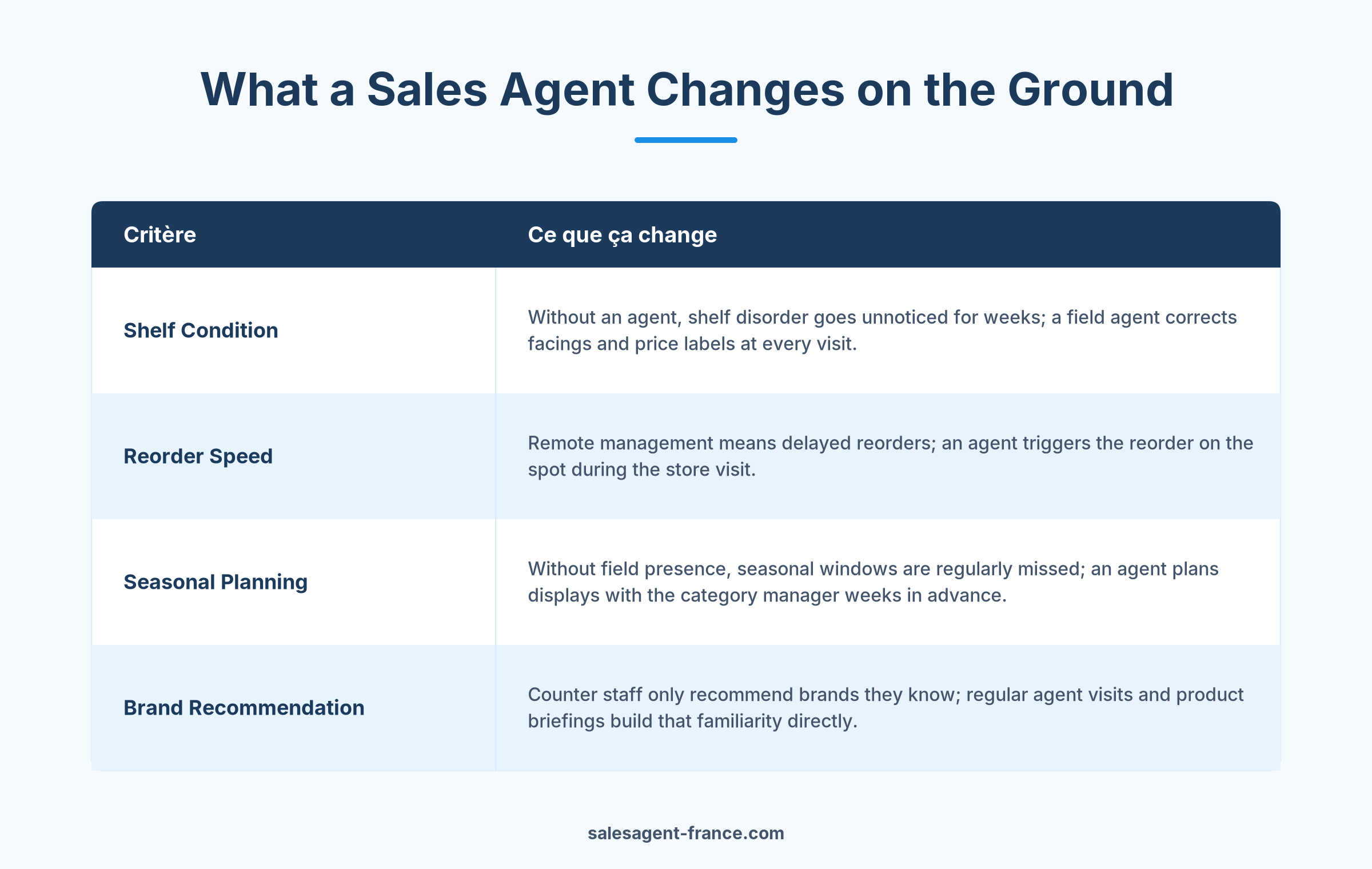
| Without a field sales agent | With a field sales agent |
|---|---|
| Initial listing obtained; follow-up from head office only | Regular visits to every point of sale; reorders triggered on the spot |
| Shelf condition unknown until a complaint is received | Shelf audit at each visit; facings corrected, out-of-stocks flagged immediately |
| Seasonal windows missed; product arrives too late or too early | Seasonal planning done 8–12 weeks in advance with the category manager |
| Counter staff at builders’ merchants do not recommend the brand | Regular product briefings; counter team confident recommending the range |
| New references take 12–18 months to gain traction | New references listed and active within one commercial cycle |
The Multicarte Advantage: Cost Shared, Presence Doubled
One question manufacturers ask frequently is whether a multicarte sales agent — one who represents several complementary brands simultaneously — truly serves each principal well. The answer, from three decades of practice, is yes: provided the portfolio is coherent and the brands are not competing.
An agent visiting a Tout Faire Matériaux branch on behalf of a fixation brand, a cutting-tools brand, and an EPI brand covers three revenue streams in a single call. The cost of the visit is shared; the relationship with the branch manager is deeper, because the agent arrives with a broader conversation and more reasons to be useful. This is the structural logic of the multicarte model: the manufacturer gains full field coverage at a fraction of the cost of a salaried representative.
Go Distribution’s 6 field agents cover approximately 1,700 points of sale across 31 departments. A manufacturer attempting the same coverage with employed sales staff would need to budget for salaries, social charges, vehicles, and management overhead — a fixed cost whether or not sales are made. With a commission-based agent, the cost is strictly variable and tied to results. You can read a detailed breakdown of this comparison in our article on why manufacturers outsource their sales force.
There is also a second advantage that rarely appears in cost models: market intelligence. A field agent visiting 1,700 points of sale across PACA, Occitanie, and Nouvelle-Aquitaine sees competitor product placements, price movements, promotional calendars, and emerging demand signals weeks before they appear in any market report. That information, fed back to the manufacturer through structured reporting, is itself a competitive asset. Learn more about how Go Distribution approaches the different missions of a commercial agent.
You are looking to distribute your products in France?
Go Distribution places your ranges in garden centres, DIY superstores, builders’ merchants, industrial supply houses, and ironmongers — 30 years of field experience across the South of France.
Frequently Asked Questions
How many points of sale can a single sales agent realistically cover in southern France?
It depends on the geographic density and the call frequency required per account. At Go Distribution, each of our 6 field agents manages a defined territory within a 31-department zone, collectively covering around 1,700 active points of sale. Call frequency is adjusted by account tier — key accounts receive more visits, smaller independents a lighter but still regular schedule.
Does working with a multicarte agent mean my brand receives less attention than it would with a dedicated representative?
Not in a well-structured multicarte portfolio. The key is that the brands represented must be complementary, not competing. When an agent arrives at a builders’ merchant with a fixation range, a cutting-tools range, and an EPI range, each brand benefits from a richer conversation than a single-card representative could generate. See our article on the advantages of working with a commercial agent for a fuller explanation.
What reporting does a sales agent provide to the manufacturer?
A professional field agent provides structured visit reports covering shelf conditions, stock levels, competitor activity, and order intake. At Go Distribution, this reporting feeds directly back to each manufacturer, giving them visibility over their network in real time — without needing to employ a field manager to gather the data themselves.
Conclusion
The role of a sales agent in French distribution is built on one simple principle: products that are visited, explained, and maintained on shelf sell more than products that are not. Whether your range belongs in a Leroy Merlin garden department, on the counter of a Gedimat branch, or in the catalogue of a Legallais industrial supply house, the agent who visits that point of sale regularly is the most reliable growth lever you have. If you are ready to build that presence across the South of France, we are happy to discuss how Go Distribution can represent your brand. Get in touch with our team.
