



Advantages of using sales agents

Working with commercial sales agents in France is one of the most effective ways for a European or international manufacturer to enter the French market with limited risk. Whether you want to win new clients, launch a new product range in DIY superstores, garden centres, builders’ merchants or industrial supply networks, or simply test a new territory, you face a fundamental choice from the outset:
- Building an in-house team with salaried employees based in France
- Partnering with an independent sales agency or commercial agents already operating in France
Here is what 30 years of ground-level experience in Southern France tells us about the real advantages of the second option.
Advantages of working with commercial agents
An established network, ready to use
 |
A commercial agent typically already visits your potential clients on a regular basis. Because he represents complementary brands, he has built solid, trusted relationships with buyers and category managers across his territory.
By partnering with him, you immediately tap into that network. Your product range is introduced during his next rounds — targeting exactly the right outlets, quickly and efficiently, without months of cold prospecting. |
A clearly defined geographic territory
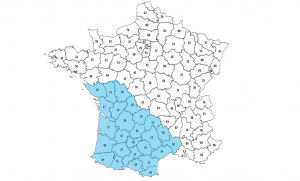
When you first meet a prospective sales agent, one of the key points to agree on is the geographic area he will cover and the type of outlets he will target. Keep in mind that a seasoned agent already has a well-established client typology — garden centres, DIY superstores, builders’ merchants, industrial suppliers, ironmongers — where he is known and trusted. Aligning your target channels with his existing footprint dramatically accelerates your market entry.
At Go Distribution, for instance, our six field agents cover 31 departments across Southern France, from Bayonne to Marseille, following approximately 1,700 points of sale across five distribution channels.
No human resources headaches
The commercial agent is an independent professional, not an employee. In most cases he runs his own structure — sometimes with his own staff. You are therefore freed from all the obligations that come with employing someone in France: social charges, payroll administration, labour law constraints, and the costs of a bad hire.
According to data published in 2026, French employer social charges add roughly 40 to 45 percent on top of base salary. Factor in tools, management overhead and the average recruitment timeline of nearly 40 days (up 20% since 2022), and the real fully-loaded cost of an in-house sales representative quickly becomes substantial — well before a single order is placed.
A cost structure with no fixed risk
This is perhaps the clearest financial advantage: you pay commissions only when sales are made. If volumes fall, your costs fall in proportion. If the agent does not sell, he earns nothing — which means he is strongly motivated to perform. There is no fixed salary, no notice period costs, and no idle payroll during slow seasons.
This commission-based model makes the commercial agent particularly well-suited to manufacturers who want to externalise their sales force without committing to heavy fixed structures from day one.
When is the right time to bring in a sales agent?
You can appoint a commercial agent in France at any stage of your development — when entering the market for the first time, when expanding into a new region, or when a specific channel (such as DIY superstores or industrial supply networks) requires dedicated, specialist coverage. Many manufacturers combine both approaches: a core in-house team supported by independent agents for specific territories or channels.
Ending the collaboration: what French law says
The commercial agent relationship is governed by a written contract. Terminating it is straightforward in principle: either party may give notice according to the agreed terms. However, French law does provide the agent with specific protections upon termination.
Under Article L.134-1 of the French Commercial Code, the agent is entitled to compensation for the loss of future income earned in the common interest of both parties. French courts typically refer to a benchmark of approximately two years of commissions, though recent case law (including a Poitiers Court of Appeal ruling of December 2023 and a Versailles Court of Appeal ruling of January 2024) has confirmed that courts assess each case on its specific circumstances — the two-year figure is a reference point, not an automatic entitlement.
Non-compete and confidentiality clauses
To prevent an agent from immediately working for a direct competitor after the contract ends, it is common — and advisable — to include a non-compete clause in the agency agreement. Under French law (Article L.134-14), such a clause must be in writing, is limited to a maximum of two years after termination, and must be accompanied by financial compensation to the agent. Without that compensation, the clause is unenforceable.
Summary: commercial agent vs. salaried employee in France
| Legal framework | French Commercial Code (Art. L.134-1 et seq.) — independent professional status |
| Remuneration | Commission on sales volumes — no fixed salary |
| Subordination relationship | No — the agent operates independently |
| Employer social charges | None for the principal |
| Ending the contract | Notice period as agreed; contract terms must be honoured |
| Termination indemnity | Typically ~2 years of commissions (court-assessed case by case, per 2023–2024 case law) |
| Non-compete clause | Possible — max. 2 years, must be in writing and financially compensated |
Questions fréquentes
Does a commercial agent in France need to be officially registered?
Yes. Commercial agents established and operating in France must register with the registry of commercial agents held by the competent commercial court (greffe du tribunal de commerce). Failure to register may result in a fine of up to €1,500. Agents based outside France who only operate there occasionally are not required to register.
Can a commercial agent represent several competing brands at the same time?
Not without your agreement. A multi-card commercial agent typically represents several complementary, non-competing brands. If you grant an exclusive mandate for your product category, the agent is contractually bound not to represent a direct competitor within the agreed territory.
How quickly can a sales agent start generating results in France?
Because a good agent already visits your target outlets regularly, the ramp-up time is far shorter than with a new hire. In practice, first orders can appear within weeks of signing the agency agreement — provided your product range is competitive and the agent’s existing network matches your target channels.
Vous cherchez à distribuer vos produits en France ?
Go Distribution places your ranges in garden centres, DIY superstores, builders’ merchants, industrial supply networks and ironmongers — 30 years on the ground in Southern France.
If you are considering distributing your products through French specialist retail or trade networks, working with an independent commercial agent is very often the most efficient and lowest-risk route. Go Distribution has been doing exactly this since 1994 across Southern France. Get in touch to discuss your project and find out whether our network matches your distribution targets.
