



How to Sell Your Products in French DIY Stores: Complete Guide
Selling your products through French DIY superstores is one of the most powerful levers for a manufacturer looking to grow sales in France: the channel is worth tens of billions of euros and reaches millions of consumer and trade customers. But between the first contact with a central buying office and a range that genuinely performs on the shelf, the journey is long, highly codified and demanding. This step-by-step guide gives you the complete method, from the listing application to in-store follow-up, backed by the latest market figures. It draws on Go Distribution’s 30 years of experience with DIY retail chains across the South of France.
Why DIY retail remains a strategic channel for manufacturers
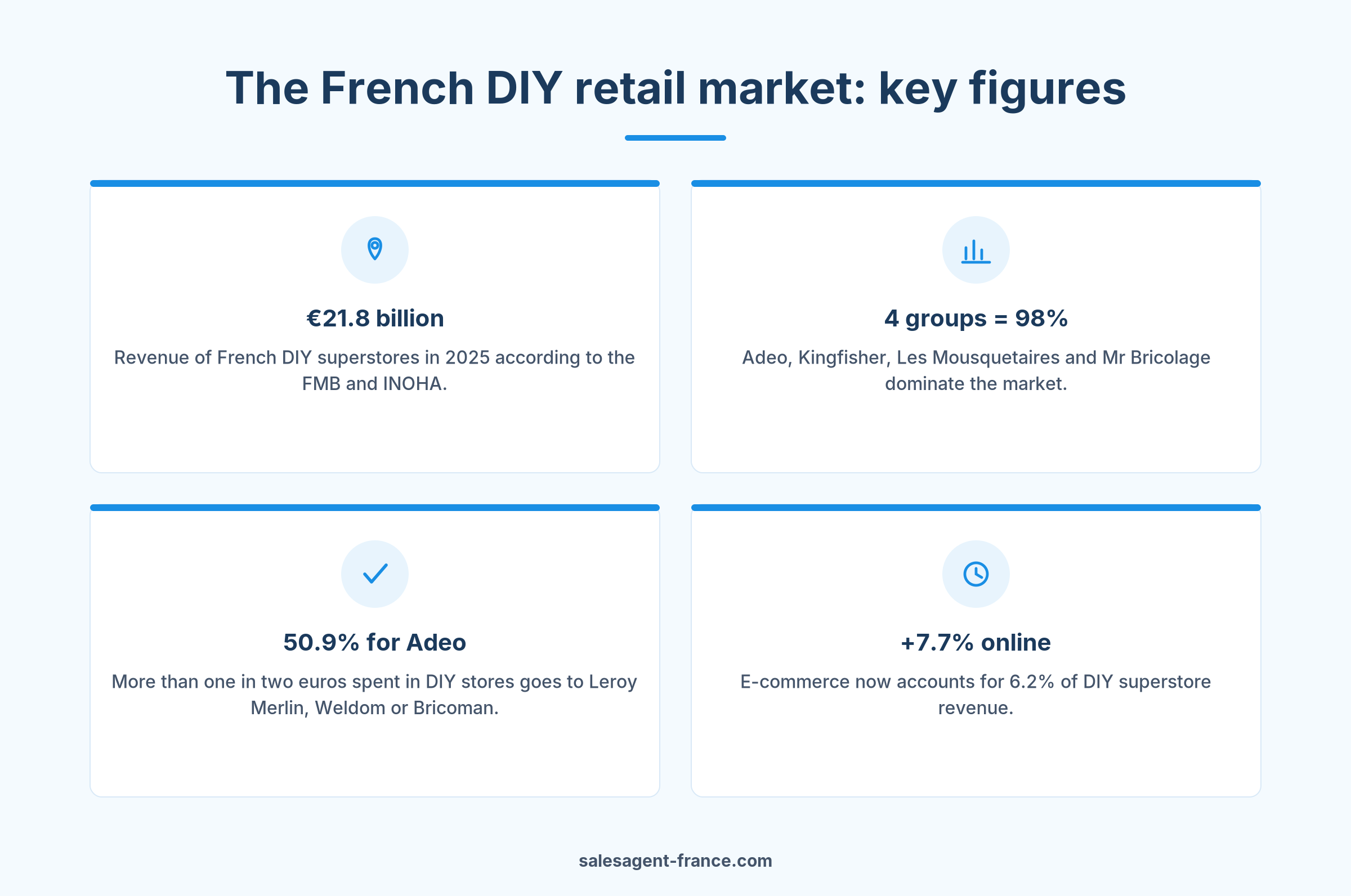
Despite a cautious economic climate, the DIY retail channel remains massive. (cite index=”7-2,7-3″>According to the FMB and INOHA (2025 study), revenue from French DIY superstores stands at €21.8 billion, a limited decline of -1.4% after -4.3% in 2024, and the market remains above its pre-Covid level. For a manufacturer of tools, fixings, hardware or home equipment, it is quite simply the leading consumer sales channel in France.
The channel is also highly concentrated, which shapes your approach strategy. (cite index=”4-13,4-14″>Four groups hold 98% of total revenue: Adeo (Leroy Merlin, Weldom, Bricoman), Kingfisher (Castorama, Brico Dépôt), Les Mousquetaires (Bricomarché, Bricocash, Bricorama) and Mr Bricolage (Républik Retail, 2026). (cite index=”4-2,4-3″>Adeo alone posted €11.1 billion in revenue in 2025 with a market share of 50.9%: a listing with two or three groups is enough to cover most of the market, but each point of entry is fiercely contested.
One last signal to factor in: digital. (cite index=”7-6″>Online sales at DIY superstores are growing by +7.7% and now account for 6.2% of revenue, while in-store sales are down -1.9% (FMB/INOHA, 2025). Your supplier file will therefore need to be just as strong on web content (product sheets, imagery, enriched data) as on the physical shelf.
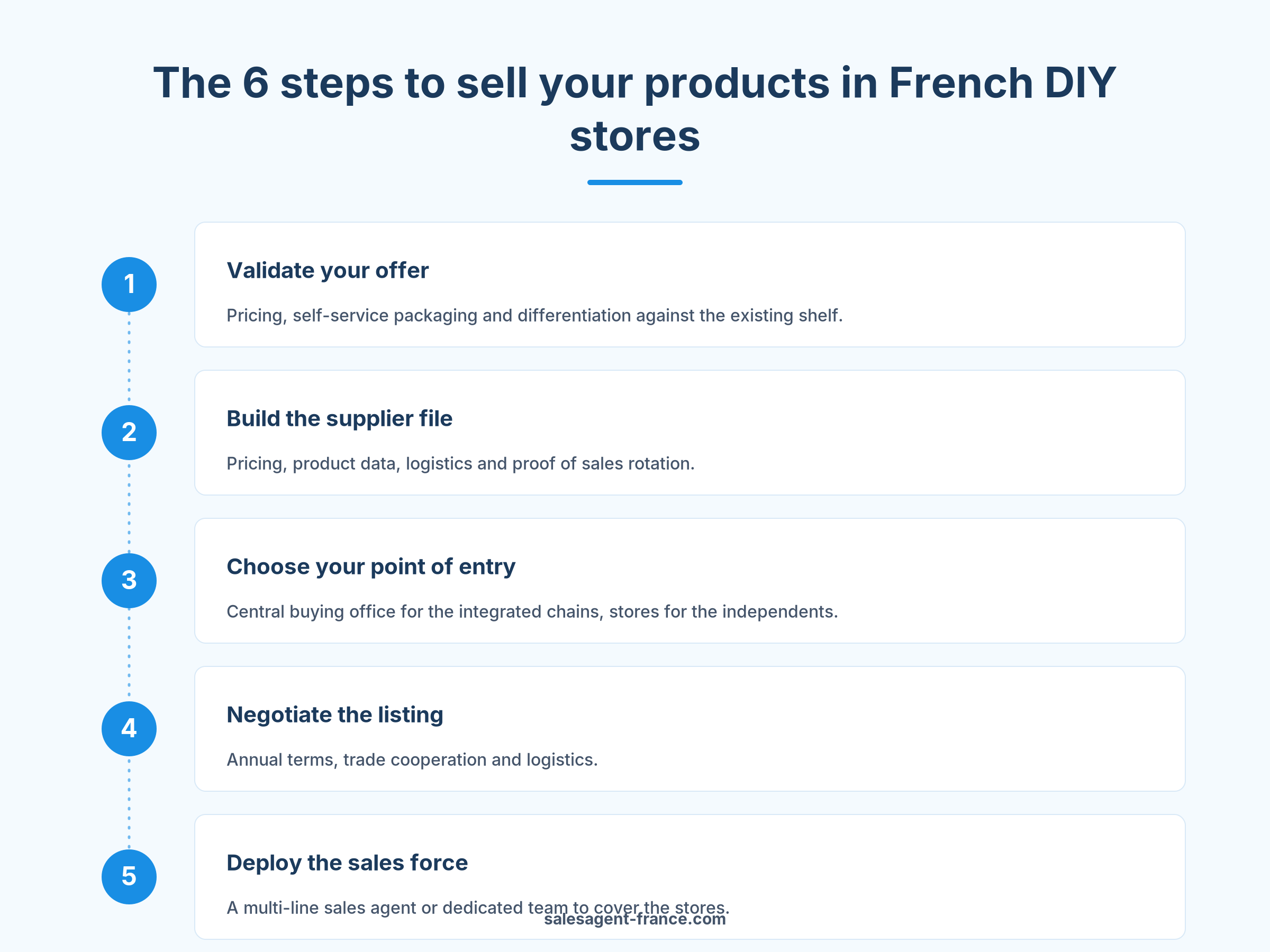
The method: selling your products in French DIY stores in 6 steps
Step 1: check that your offer fits the channel
Before making any contact, check that your range matches what French DIY retailers expect: a retail price consistent with the chain’s positioning, self-service packaging (blister packs, boxes, gondola-end potential), instructions in French, CE and regulatory compliance. A preliminary market study will spare you from presenting a range that falls outside the standards of the aisle.
Also analyse the competition already listed: which brands, which prices and which private labels occupy the shelf space? Your offer must bring clear differentiation to the category manager: product innovation, better margin, a range extension or an associated service.
Step 2: build a flawless listing application
The central buying office judges a file first. It must contain:
- Pricing and terms: standard price list, discounts, logistics terms, trade cooperation budget;
- Product data: EAN/GTIN codes, pack quantities, dimensions, weights, technical data sheets, HD photos, e-commerce content;
- Logistics capabilities: target service level (98% and above), delivery lead times, EDI, ability to deliver to warehouse or store;
- Market evidence: existing listings, sales rotation figures from other channels, consumer tests.
Step 3: choose your point of entry — national buying office or the field
Two routes coexist depending on the retailer. With the integrated chains (Leroy Merlin, Castorama, Brico Dépôt), listing goes through the central buying office and national category managers; (cite index=”2-6″>Leroy Merlin, the market leader with €8.98 billion in revenue, centralises its purchasing heavily. With the independent retailer groups (Mr Bricolage, Bricomarché, Weldom), member stores retain local purchasing autonomy: prospecting store by store can create the traction that will later convince the central buying office.
This is where a regionally established sales agency comes into its own: it knows the member store owners, the department managers and the decision-making channels of each retail chain. That is precisely the role of a multi-line sales agent specialising in DIY retail.
Step 4: negotiate the listing and annual terms
Negotiation covers far more than price: trade cooperation, participation in catalogues and promotional campaigns, terms for taking back unsold stock, logistics penalties. Factor these costs into your pricing structure from the outset. A poorly constructed price list in year one will cost you for the entire life of the listing, because retailers negotiate on cumulative terms year on year.
Step 5: deploy a field sales force
Being listed with the central buying office guarantees neither in-store placement, nor restocking, nor a well-maintained shelf. Regular visits are essential: presenting new products to the department manager, checking stock, flagging out-of-stocks, defending your shelf facings. For a French or European manufacturer, recruiting salaried sales reps across the whole of France is costly and slow; outsourcing your sales force to a sales agency already established in the stores means being operational within a few weeks, with commission-based remuneration proportional to sales.
Step 6: drive sell-out and monitor performance
The final step never ends: getting the product out of the store. In concrete terms:
- in-store demonstrations and events during key seasons;
- merchandising: point-of-sale displays, dump bins, gondola ends, in-aisle cross-selling;
- reporting: sales rotation per store, out-of-stocks, feedback from department managers;
- competitive monitoring to adjust range and pricing each season.
This field intelligence feeds your annual negotiations: a supplier who brings rotation figures and evidence of in-store activity carries far more weight with the central buying office.
What measurable benefits for your business?
A well-executed DIY retail journey produces quantifiable results. First in volume: a few dozen well-placed SKUs within a single group can mean hundreds of stores supplied, with recurring, predictable revenue. Then in brand awareness: a presence on DIY superstore shelves lends your brand credibility with other channels — builders’ merchants, hardware stores, industrial supplies — which Go Distribution also covers.
The sales agent model also makes the cost of the exercise measurable: no fixed salaries, no company vehicles, no remote team management, but a commission on sales actually achieved. For a European manufacturer testing the French market, it is the safest way to limit risk while benefiting from a network of relationships built over 30 years — in our case, around 1,700 stores covered from Bayonne to Marseille. The brands we represent, such as SPIT in fixings or Mottez in storage, rely on precisely this continuous field presence to defend their shelf share.
Frequently asked questions
How long does it take to get listed in French DIY stores?
Allow generally 6 to 18 months between first contact and first deliveries, depending on the retailer and the range review window for the relevant department. The independent retailer groups often offer shorter timelines through member stores’ direct purchasing.
Should you go through the central buying office or approach the stores?
The two approaches complement each other. With the integrated chains, the central buying office is unavoidable; with the independents (Mr Bricolage, Weldom, Bricomarché), success at store level is a strong argument for subsequently securing a national listing.
Can a multi-line sales agent manage the relationship with central buying offices?
Yes: a sales agent can present your ranges to category managers, follow range reviews and provide the in-store relay. The distribution mandate sets out the exact scope (retail chains, geographical territory, possible exclusivity).
Looking to sell your products in France?
Go Distribution places your ranges in garden centres, DIY stores, builders’ merchants, industrial supplies and hardware stores — 30 years in the field across the South of France.
Conclusion: a demanding journey, but a well-marked one
Selling your products in French DIY stores requires method: a well-calibrated offer, a complete listing application, the right point of entry for each retailer, and above all a field presence that turns a listing into lasting sales. None of these steps is beyond the reach of a well-supported manufacturer. If you are preparing your entry into the French DIY market, let’s discuss your project: we have known these aisles from the inside since 1994.
