



Selling to French Garden Centres: What Manufacturers Need to Know
Selling to French garden centres (jardineries) is one of the most rewarding distribution routes available to European manufacturers — provided you understand how the channel really works. With approximately 1,580 specialist garden centre and seed-merchant outlets generating a combined turnover of €3.1 billion in 2024 (source: Valhor / Xerfi Specific, 2025), the network is large, structured, and demanding in equal measure. This guide walks you through every stage of the process, from your first contact with a buying group to the in-store activation that actually shifts stock.
Why French Garden Centres Are a Serious Opportunity — and a Genuine Challenge
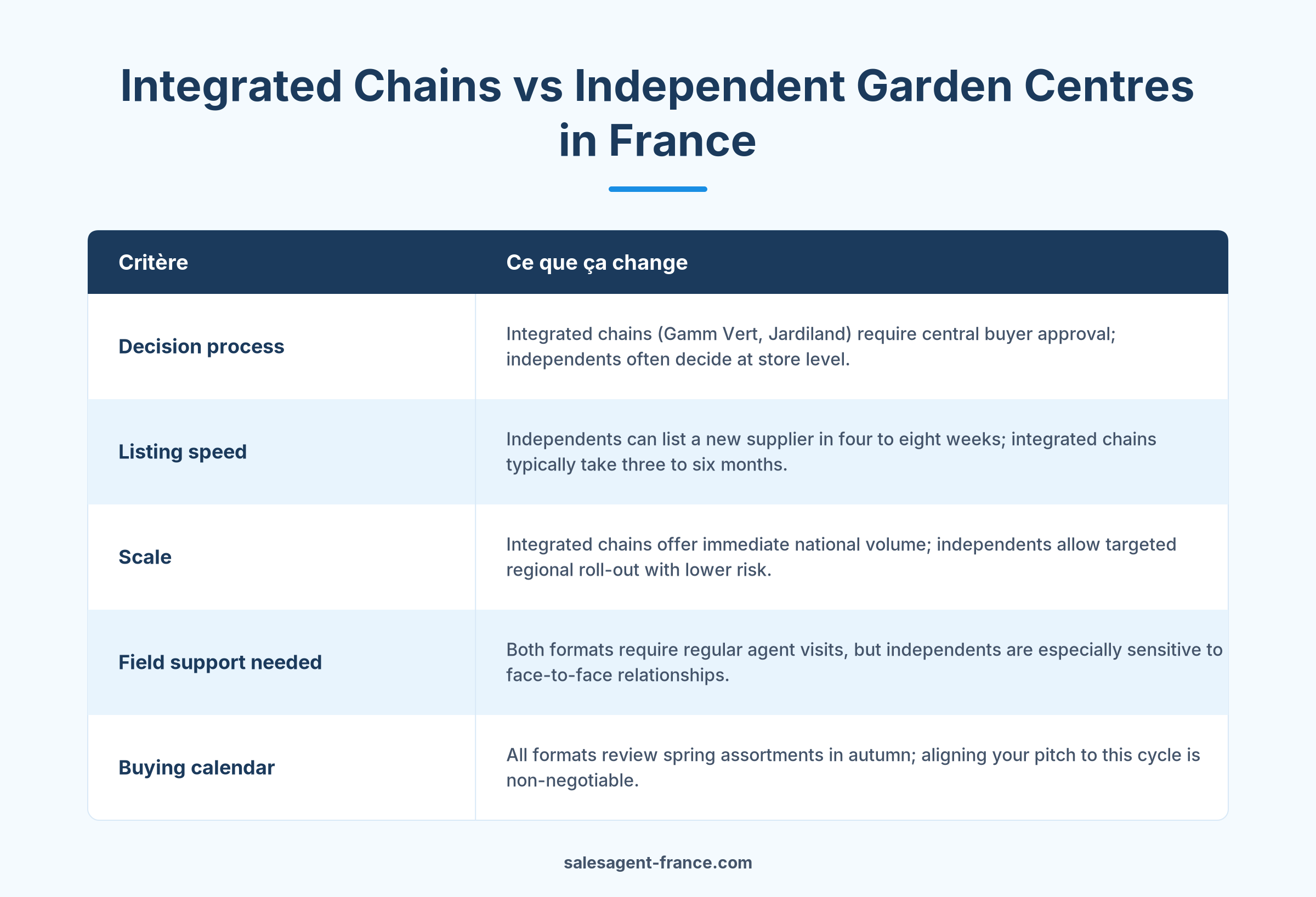
The French garden channel is the single largest distribution circuit for garden products in France, accounting for roughly 39.8% of the total market by value (source: Republik Retail / Promojardin-Promanimal data, 2025). The main integrated chains — Gamm Vert (part of the Teract group, over 1,100 outlets), Jardiland, Truffaut, and Botanic — sit alongside a dense fabric of independent stores affiliated to buying groups such as Adoxa, J’DEA, Inédis, and SO’Jardineries.
That fragmentation is the core challenge. Each network has its own logic: centralised listing decisions for the integrated chains, store-by-store negotiation for the independents. A one-size-fits-all approach will not work. Add to that a pronounced seasonality — spring (March to May) is the dominant trading period — and you have a channel that rewards preparation and penalises reactive selling.
Consumers, for their part, are discerning. Research from Kantar Media (2025) shows that French gardeners prioritise product longevity, ease of use, and brand reputation well ahead of price. That is good news for quality manufacturers — but it means your in-store presentation and your field sales support must match the promise on the packaging.
Your Step-by-Step Method for Entering French Garden Centres
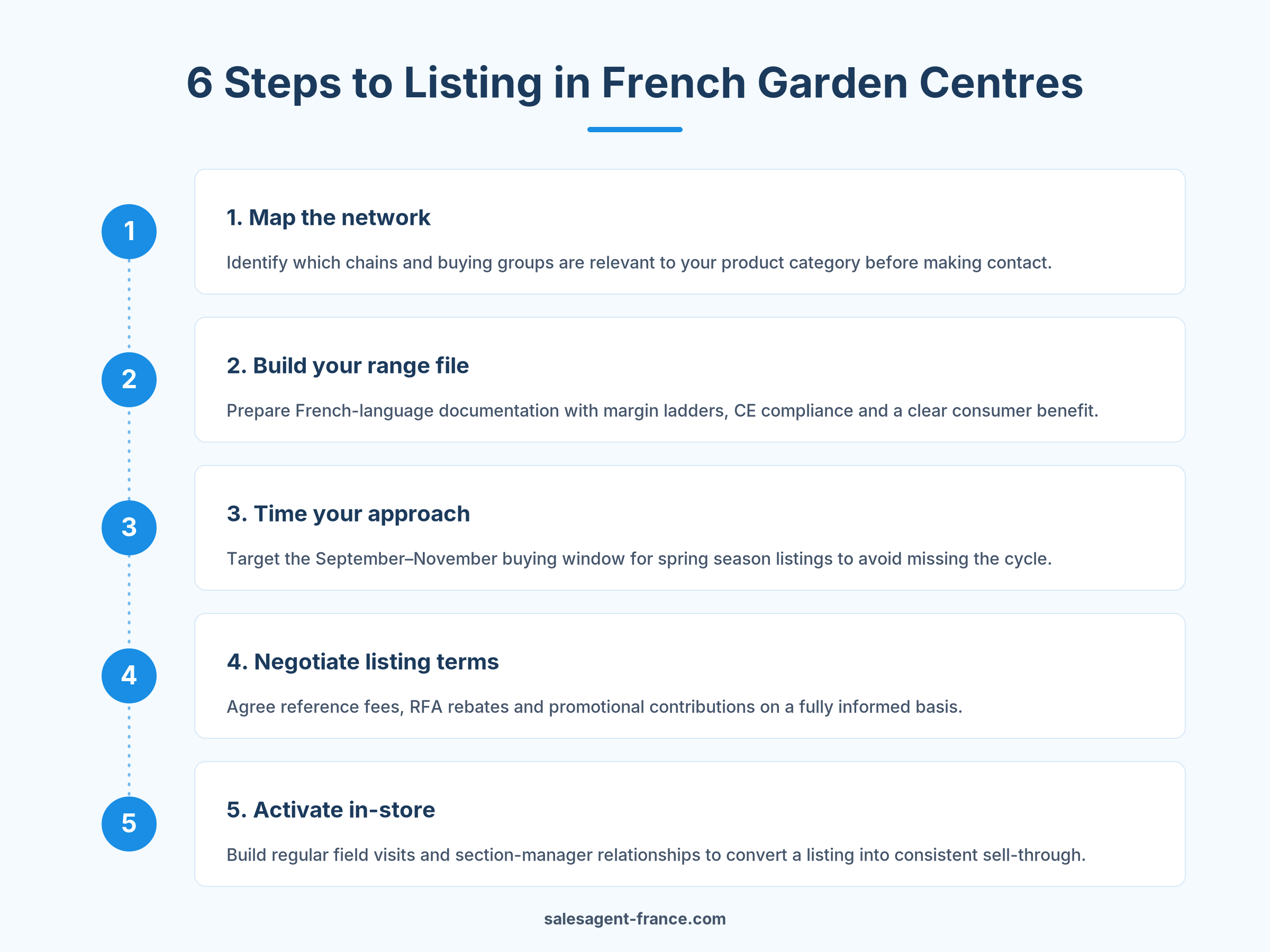
Step 1 — Map the network that fits your category
Before approaching anyone, clarify which part of the garden centre circuit is relevant to your product range. Manufactured garden goods (fixings, tools, security products, storage, EPI) sit primarily in the non-plant aisles — a very different buying logic from the plant and soil side of the business. The integrated chains handle these categories via central buyers; independents often make their own decisions within a buying-group framework.
- Integrated chains: Gamm Vert, Jardiland, Truffaut, Botanic — central listing required.
- Independent buying groups: Adoxa, J’DEA, SO’Jardineries, Inédis — listing gives visibility, but individual store orders still need chasing.
- Standalone independents: negotiated store by store; faster to list, slower to scale.
Step 2 — Build a range file that speaks to French buyers
French garden centre buyers are professionals who see dozens of supplier presentations each year. Your file must answer three questions immediately: what problem does this product solve for the end consumer, how does it fit the existing planogram, and what margin does it generate? Translated product names, French-language back-of-pack copy, and CE compliance documentation are non-negotiable before any meeting.
Pricing should be presented with a full margin ladder: supplier price, recommended shelf price, and the implied margin for the retailer. Failing to provide this upfront is one of the most common reasons a first meeting leads nowhere.
Step 3 — Approach buying groups and central buyers with the right timing
Buying decisions for the spring season are typically made between September and November of the preceding year. Missing that window means waiting another twelve months. For summer and autumn ranges, buyers review assortments in spring. Knowing this calendar and presenting at the right moment is a basic condition of success — yet it is something that suppliers approaching the market remotely routinely get wrong.
At Go Distribution, we maintain continuous relationships with the buying teams active across the South of France (PACA, Occitanie, Nouvelle-Aquitaine). That means your range file lands at the right desk, at the right time, carried by someone the buyer already knows.
Step 4 — Negotiate the listing conditions and commercial framework
French retail listing agreements typically include: a reference fee (droit de référencement), annual end-of-year rebates (remises de fin d’année, or RFA), co-op advertising contributions, and sometimes a stocking obligation. These are standard, not exceptional. The balance between these elements is negotiable, and knowing what comparable categories generate is essential to avoiding an agreement that makes distribution unprofitable from day one.
- Reference fees: variable, often waived for strong or in-demand brands.
- RFA: typically 2–5% of annual turnover, sometimes higher in integrated chains.
- Promotional contributions: in-store displays, seasonal catalogue inclusions, promotional pricing events.
Step 5 — Activate the range in-store once listed
This is the step most manufacturers underestimate. A listing is a permission to sell, not a guarantee of sales. Section managers (chefs de rayon) are the key relationship at store level: they decide where your product sits on the shelf, whether it is reordered when stock runs low, and whether it gets a secondary placement during a promotional event. Field visits — regular, planned, and face-to-face — are the only way to build and maintain that relationship.
At Go Distribution, our six field sales agents cover around 1,700 points of sale across 31 departments. Each visit follows a structured sequence: stock check, planogram compliance, shelf hygiene, reorder confirmation, and a brief debrief with the section manager. That discipline is what keeps a range alive between seasons.
Step 6 — Run in-store demonstrations and animations at peak season
For products that benefit from a live demonstration — cutting tools, fixing systems, garden security products — in-store animations at key spring and autumn weekends can multiply sell-through dramatically. Go Distribution organises and staffs these animations directly, briefing demonstrators on product benefits and tracking the impact on weekly sales. For brands such as Alpha Coupe (cutting tools) or Master Lock (garden security), this kind of activation is built into the annual commercial plan from the outset.
What Measurable Gains Can You Expect?
The benefits of a disciplined approach to the French garden centre channel are concrete and trackable. Manufacturers who enter the market with a local field partner rather than relying on remote account management typically see:
- Faster listing: relationships already in place with buying groups and section managers compress the time from first contact to first order.
- Higher sell-through rates: regular field visits catch out-of-stocks and planogram drift before they erode sales — a critical advantage in a seasonal channel where a missed spring weekend cannot be recovered.
- Lower cost of sales: a multicarte agent shares its fixed costs across several complementary, non-competing product ranges; the cost per point of sale is a fraction of what a dedicated salaried sales force would generate. For a detailed breakdown, see our analysis of the real advantages of working with a commercial agent.
- Reliable reporting: structured visit reports, sell-out data by store, and competitive intelligence fed back to the manufacturer on a regular cycle.
The 1,700 points of sale monitored by Go Distribution across the South of France include jardineries, DIY superstores, builders’ merchants, industrial supply distributors, and ironmongers. That breadth means a manufacturer entering the garden centre channel can, when the time is right, extend naturally into adjacent circuits — without changing commercial partner. For more on how the broader distribution model works, visit the Go Distribution homepage.
Questions fréquentes / Frequently Asked Questions
How long does it typically take to get a product listed in a French garden centre chain?
For integrated chains such as Gamm Vert or Jardiland, the listing process — from first presentation to first confirmed order — generally takes three to six months, depending on the buying cycle. Independent garden centres affiliated to buying groups can move faster, sometimes within four to eight weeks, particularly when a local field agent facilitates the introduction. Timing your approach to align with the buying calendar (September–November for spring) is the single biggest factor.
Do I need to appoint a French distributor before approaching a garden centre buying group?
Not necessarily. A commercial agent operating under a distribution mandate can represent your brand directly with buying groups and individual stores without you needing a French subsidiary or a wholesale distributor. This is the model Go Distribution operates: we act in your name, carry your price list, and negotiate on your behalf — which is both faster and less capital-intensive than setting up a local distribution entity. Learn more about how a multicarte agent works in practice.
Which product categories perform best in French garden centres outside of plants and soil?
The non-plant aisles of a French garden centre are increasingly important to overall store margin. Fixings, garden security (padlocks, chains), cutting tools, outdoor storage, and DIY accessories all perform well when they are actively sold and properly displayed. Categories that benefit from a demonstration — such as cutting tools or powered garden equipment — have consistently higher conversion rates when in-store animation is part of the commercial plan.
Looking to distribute your products across France?
Go Distribution places your ranges in garden centres, DIY superstores, builders’ merchants, industrial suppliers and ironmongers — 30 years of field experience across the South of France.
Conclusion
The French garden centre channel is structured, seasonal, and relationship-driven. Getting listed is a necessary first step, but it is in-store execution — regular field visits, strong ties with section managers, and timely in-store animation — that ultimately determines whether your range grows or stagnates. With 30 years of experience across the South of France and an active presence in around 1,700 points of sale, Go Distribution brings both the network access and the daily field discipline that manufacturers need to succeed in this channel. If you are ready to take the next step, get in touch with our team to discuss a distribution mandate.
