



Exclusive Distribution Mandate in France: 6 Tips That Work
An exclusive distribution mandate in France is the legal instrument that ties a manufacturer to a single commercial agent for a defined territory — and when it is drafted and executed well, it is the most efficient route into French retail and trade networks. At Go Distribution, every partnership we sign with an industrialist begins with this document. After more than 30 years covering 31 départements from Bayonne to Marseille, we have seen what makes a mandate perform and what makes it stall. These six practical tips draw directly from that experience.
Define the territory precisely — not just “southern France”
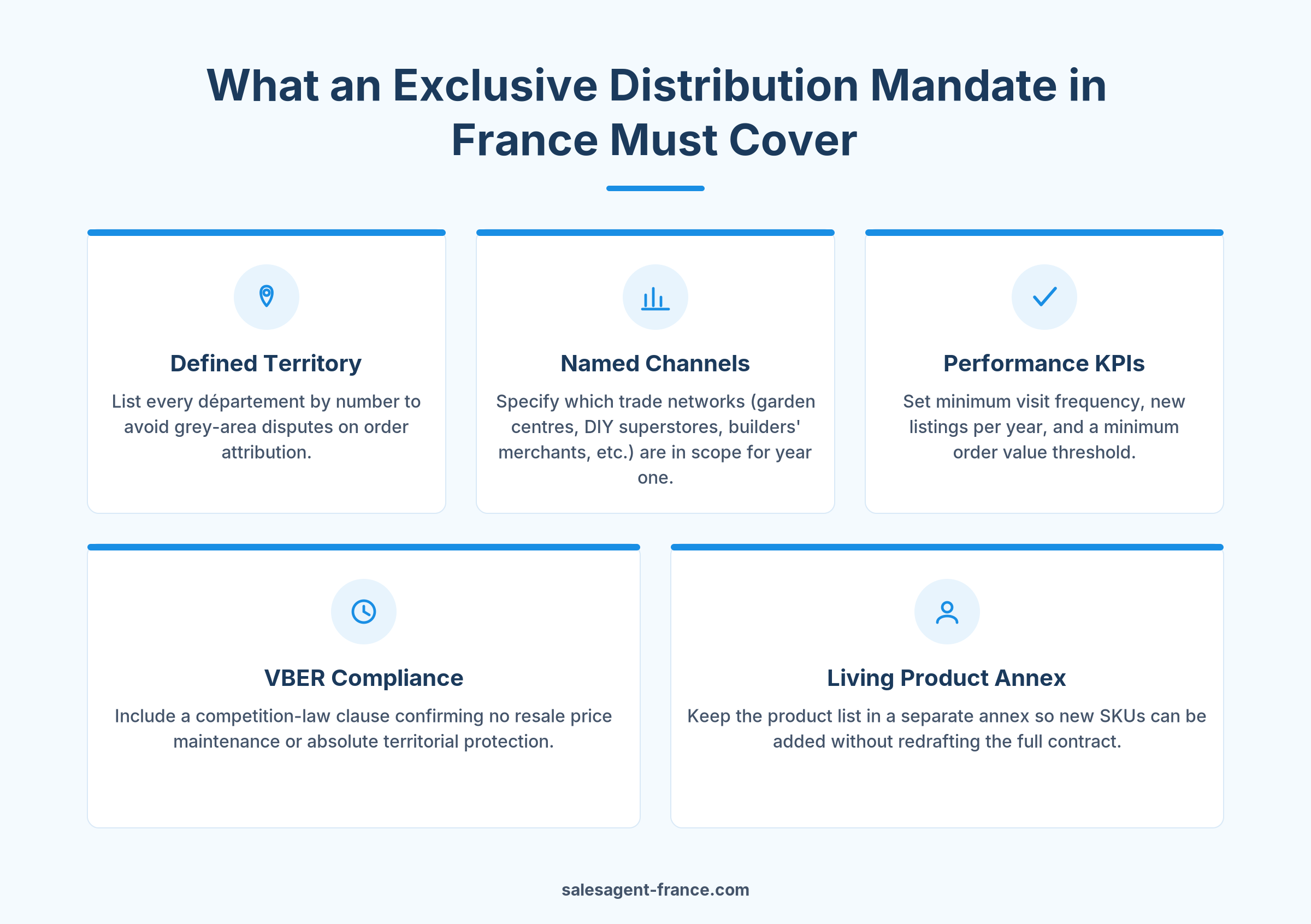
Vague territorial wording is the single most common source of conflict in commercial agency agreements. Under Article L.134-1 of the French Code de Commerce, a commercial agent mandate must clearly establish the scope of the agent’s authority. In practice, this means listing the exact départements covered, not just a broad regional label.
At Go Distribution, our mandate covers 31 specific départements from the Pyrénées-Atlantiques to the Bouches-du-Rhône. This level of detail matters: it protects the manufacturer from grey-area disputes when a buyer based in one city places an order through a head office registered elsewhere. It also gives the agent a clear brief — which accounts to visit, which regional buying offices to target, and where the exclusivity actually applies.
- List every département by number and name in an annex to the contract.
- Clarify whether the exclusivity covers all channels or only specific trade networks.
- Specify how online orders originating from within the territory are handled.
Name your target channels in the mandate, not just your product categories
France’s specialist trade networks each operate under distinct purchasing logic. Garden centres (Jardiland, Gamm Vert, Botanic) work on seasonal buying plans with regional autonomy; DIY superstores such as Leroy Merlin, Castorama, and Brico Dépôt use centralised buying offices that require a formal listing file. Builders’ merchants like Gedimat, Tout Faire, and Chausson Matériaux deal with professional contractors and prioritise technical reliability over packaging. Industrial supply networks — Setin, Foussier, Legallais, Trenois Decamps, Prolians — demand robust after-sales documentation and EAN/GTIN data. Hardware shops follow yet another rhythm entirely.
Naming the channels in the mandate serves two purposes. First, it sets a shared expectation: a fixings manufacturer whose product is a natural fit for Legallais or Prolians should not expect their agent to push it into garden centres without an agreed plan. Second, it helps both parties measure performance against realistic benchmarks, channel by channel.
A well-drafted mandate will state which networks are targeted in year one and which are earmarked for expansion once the initial listings are secured and generating repeat orders.
Build in a minimum activity clause — with realistic KPIs
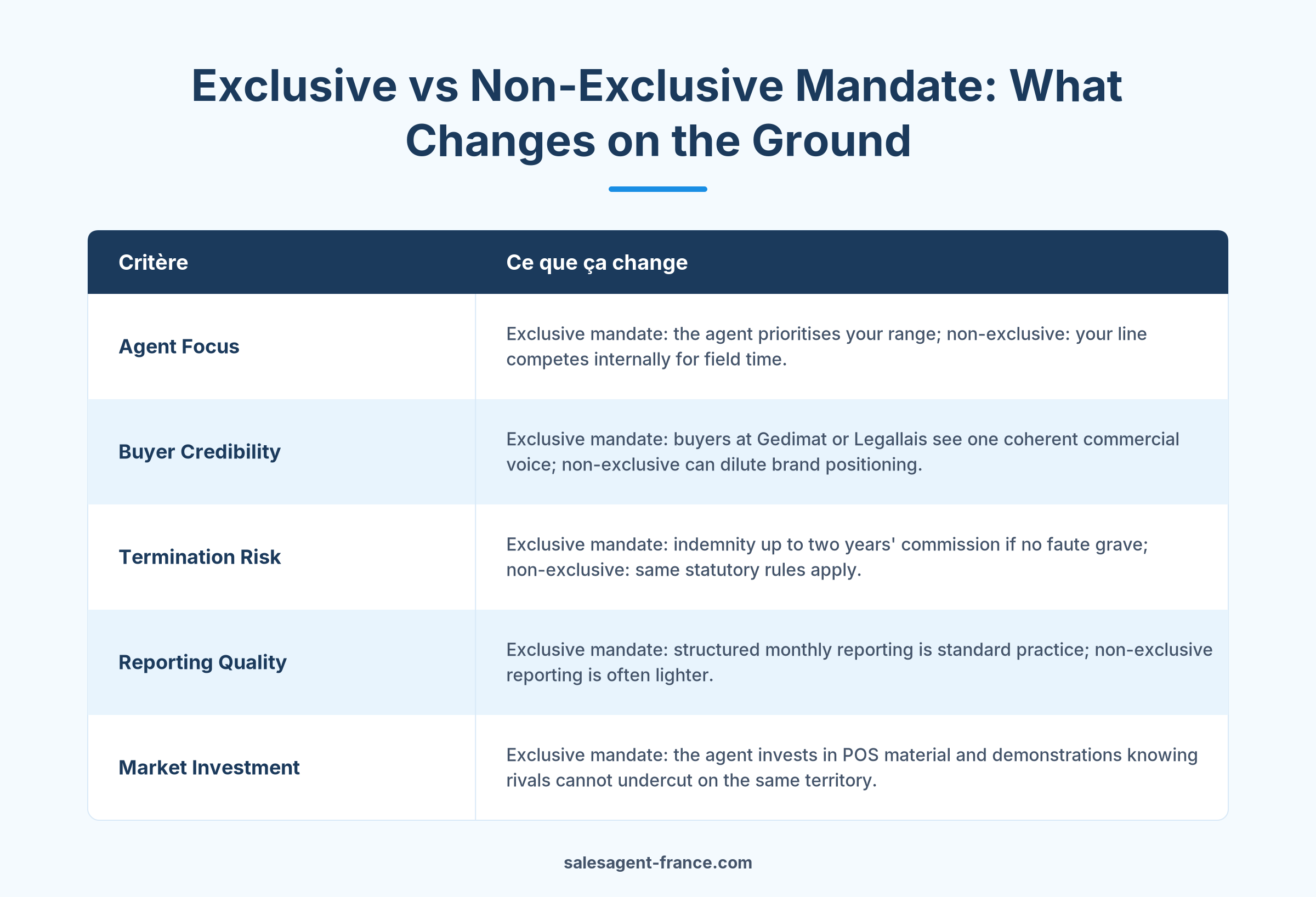
French commercial law does not imply any effort obligation in an exclusive agency agreement — the law only implies good faith (french-business-law.com). This means that without an explicit minimum activity clause, a manufacturer who grants exclusivity to an underperforming agent has very limited contractual leverage. The agent retains statutory protections under EU Directive 86/653, which France has transposed, including a termination indemnity that can reach up to two years of average commission.
Practical KPIs to include in the mandate:
- Number of active points of sale visited per quarter.
- New listings obtained per channel per year (for example, three new builders’ merchant branches in year one).
- Minimum order value generated from the territory over a 12-month rolling period.
- A reporting cadence — monthly visit reports, quarterly summaries — so the manufacturer has visibility without micromanaging.
At Go Distribution, we provide structured monthly reporting as standard. A manufacturer working with brands such as Master Lock, SPIT fixings, or Mottez knows exactly which accounts are active, which are pending a decision, and where a product demonstration is scheduled.
Respect the Vertical Block Exemption Regulation (VBER) thresholds
An exclusive distribution arrangement is lawful under EU competition rules provided neither party’s market share exceeds 30% on the relevant market, and provided the agreement does not contain hardcore restrictions such as resale price maintenance or absolute territorial protection (dreyfus.fr, 2024). These rules apply directly in France as an EU member state.
For most manufacturers entering French specialist trade channels for the first time — whether a German tools maker, an Italian fixings producer, or a Spanish EPI specialist — the 30% threshold is not a practical concern. But it is worth flagging in the contract that pricing guidance is exactly that: guidance, not a fixed resale price. Buyers at Gedimat or Foussier will renegotiate margins at their annual commercial review, and the agent needs room to operate without putting the mandate at legal risk.
A short competition-law clause, drafted by your French legal counsel, adds this protection cleanly and signals commercial credibility to French trade buyers who are used to working within these frameworks.
Include a product range annex that you can update without redrafting the whole contract
One of the most practical improvements to an exclusive distribution mandate is structuring the product scope as a living annex rather than embedding a fixed product list in the main body of the contract. French and European manufacturers who work with Go Distribution regularly expand their range — new SKUs, seasonal extensions, reformulated products — without wanting to renegotiate the entire agreement each time.
A simple clause stating that the product range is as defined in Annex A, which may be updated by written mutual agreement, gives the manufacturer flexibility to introduce a new Rapid stapling range or an Alpha Coupe cutting-tool line mid-year, with the agent’s commercial authority extending to those products immediately.
- Keep the main contract focused on territory, channels, commission rate, and legal terms.
- Use Annex A for the current product list (with EAN codes).
- Use Annex B for agreed targets and KPIs.
Plan the field activation from day one, not after the first order
A signed mandate without a field activation plan is a listing without sales. The gap between a product appearing in a buyer’s system and that product actually moving off the shelf is precisely where manufacturers lose their investment. At Go Distribution, we insist on agreeing a launch plan at the same time as the mandate — not three months later.
What a solid activation plan covers for a new mandate:
- Opening visits: the agent introduces the brand personally to key accounts in the first four to six weeks.
- Shelf implementation: correct positioning, POS material, and facing checks in line with the buyer’s planogram.
- In-store demonstrations: particularly effective for product categories such as EPI (where Difac’s range benefits from live explanation), power fixings, and garden tools.
- Reorder tracking: the agent monitors stock levels and anticipates replenishment orders before a stockout occurs.
Go Distribution follows approximately 1,700 points of sale across southern France on a regular visit cycle. That physical presence — agents who know the department managers by name — is what transforms a reference number on a buyer’s screen into consistent sell-through.
Questions frequently asked
How long should an exclusive distribution mandate in France last?
There is no statutory duration imposed for commercial agency mandates in France. Most mandates we work with run for an initial term of one to three years, renewable unless terminated with the notice period specified in the contract. A shorter initial term with a renewal option is a reasonable approach for a first partnership, giving both sides the opportunity to validate the commercial fit before committing long-term.
Can a manufacturer terminate the mandate if the agent underperforms?
Yes, but the process must be handled carefully. French law, implementing EU Directive 86/653, grants the commercial agent a termination indemnity of up to two years’ average annual commission unless the termination is for serious breach (faute grave). A well-drafted minimum activity clause — with documented evidence that it has not been met — is the clearest route to terminating without triggering the indemnity. Always seek French legal advice before serving notice.
Does Go Distribution work with manufacturers based outside France?
Yes. A significant share of the manufacturers we represent are European — from Germany, Italy, Spain, and elsewhere — who want to develop sales in southern France without establishing a local subsidiary. The exclusive mandate model is straightforward to set up under French commercial law, and an initial conversation with our team costs nothing.
Looking to distribute your products in France?
Go Distribution places your ranges in garden centres, DIY superstores, builders’ merchants, industrial supply and hardware networks — 30 years on the ground in southern France.
In conclusion
An exclusive distribution mandate in France is a powerful commercial tool — but only when it is built on precise territorial scope, named channels, enforceable performance clauses, and a realistic field activation plan. The legal framework under French commercial law and EU competition rules is clear and workable; the craft lies in aligning the contractual terms with the operational reality of the networks your products need to enter.
Whether your target is a shelf at Gedimat, a listing in a Legallais catalogue, or a demonstration bay at a Jardiland, the mandate is the starting point. If you are ready to take that step, contact Go Distribution and we will tell you honestly whether your product range fits the channels we cover. You may also find it useful to read our broader overview of the advantages of working with a commercial agent and our guide to multicarte representation in the DIY and hardware sector.
